

A Note to the Reader
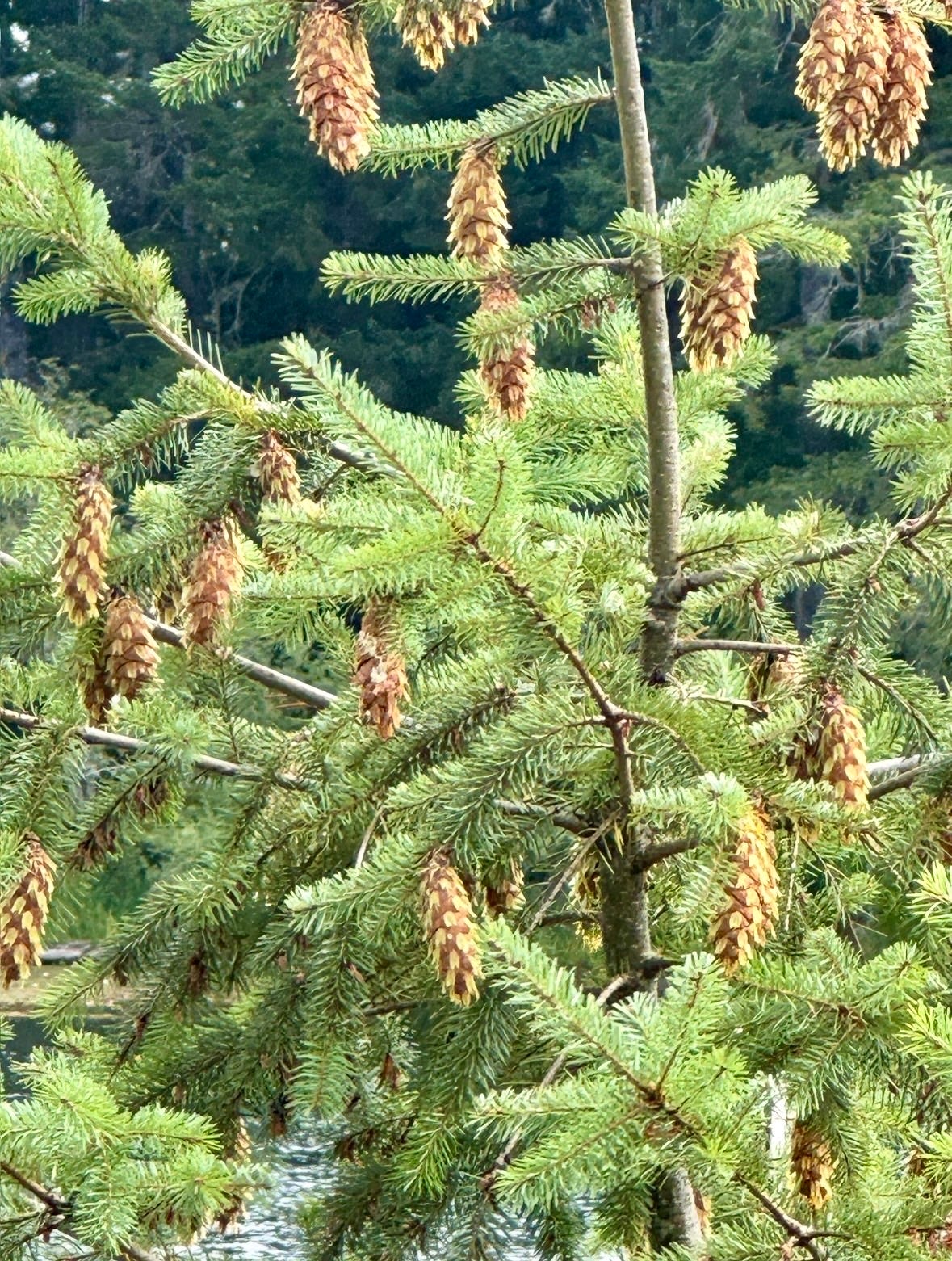
This reflection comes from my husband, G. Wray. It began with the same Douglas-fir and the same cones I have been watching and writing about—but from the other chair on the deck. I was wondering what the tree might be saying. He was quite certain he already knew what kind of tree it was.
He didn’t.
Apparently, the tree had more than one thing to teach us.
—Gilda
How many questions have I never asked because I assumed I already knew the answer?
I discovered one of them this morning.
It had been standing about ten feet from our deck for more than a year.
A tree.
As Gilda and I do most mornings, we arose and went outside to sit on the deck. We watched the sun rise over the lake, prayed together, and simply observed God in the natural world around us.
It is one of our favorite parts of the day.
There are the birds and animals that come and go. The clouds moving across the sky. The breeze over the water. Sometimes, the rain.
In the evenings, we often sit in the same place, amazed by the colors of the sunset. Then, the stars and moon.
There always seems to be something new to notice.
This particular morning, however, Gilda and I began paying attention to something we had looked at every day for more than a year.
The trees.
Not just the trees themselves, but what they were bearing.
One was absolutely covered with cones from its midpoint upward. Another, standing nearby, had considerably fewer. And towering above them was a tall, lacy-looking evergreen that seemed different from both.
Gilda asked me what kind of trees they were.
I knew the tall one.
Western redcedar.
The other two?
Pines.
Obviously.
They were evergreen. They had needles. Stiff branches. Cones hanging everywhere.
Pine trees.
Period.
Except they weren’t.
Not one of them.
When we began looking more closely, I discovered that my two “pine trees” were actually Douglas-firs.
Fine. Firs, then.
Except Douglas-firs aren’t actually true firs either.
So perhaps hemlocks?
Nope.
Spruce?
Wrong again.
The botanical name finally seemed as though it might clear things up: Pseudotsuga menziesii.
Except Pseudotsuga essentially means “false hemlock.”
Well, that certainly helped.
Apparently I had spent more than a year confidently looking at a tree I had never actually bothered to know.
The funny thing was, the tree hadn’t fooled me. It hadn’t disguised itself. It had never claimed to be a pine.
The needles I had seen were really there. So were the cones. It really was an evergreen.
Everything I had observed was true.
My mistake came in what I did with those observations.
I assumed.
I saw enough familiar characteristics to think I knew the rest of the story. And once I had decided what the tree was, there was no reason to ask another question.
Pine.
Period.
It was Gilda’s question that changed everything.
What kind of trees are these?
One question mark replaced my period.
And suddenly I was curious.
What kind of needles are these?
Why don’t they grow in bundles like pine needles?
What are those strange little pieces protruding from the cones?
What exactly is a Douglas-fir?
Why is it called a fir if it isn’t a true fir?
One question led to another.
And another.
The tree hadn’t changed.
My posture toward it had.
I have said something to Gilda, to others, and most often to myself many times over the years:
Get curious.
When I respond to something in anger, get curious.
Why did that bother me?
When someone’s reaction doesn’t make sense to me, get curious.
What might I not know?
When I find myself drawing a conclusion about another person, get curious.
What am I assuming?
Assumptions tend to have a way of becoming names. Names become labels. Labels become categories.
Before long, I may believe I know something—or someone—when what I really know is the story I have constructed from the little I have seen.
Maybe that is what troubled me about getting the tree so wrong.
I had observed a few things correctly and then supplied everything I didn’t know.
We do that with people too.
We see someone’s reaction but not what preceded it. We hear the words but don’t know the history behind them. We encounter someone halfway through a story we have never read and assume we understand the character.
Sometimes we don’t even realize we’re assuming.
Assumptions rarely introduce themselves as assumptions. They usually arrive sounding like facts.
That is why curiosity matters so much.
Curiosity doesn’t require me to deny what I see. It simply reminds me that there may be more to the story.
It leans toward another person rather than away.
It asks:
Why?
What happened?
What don’t I understand?
What am I assuming?
What haven’t I asked?
Curiosity leaves room for someone’s story to be different from the one I might have written for them.
Most importantly, it requires the humility to admit:
I may not know yet.
As I sat looking at those trees, I found myself asking the Holy Spirit a question I have learned to ask when something appears to be stirring beneath what I can immediately see:
What is the question I haven’t asked?
Often, strangely enough, the answer was the question itself.
Keep asking.
Don’t be so quick to put a period where there may still be more to the story.
The Douglas-fir had been standing there all along.
For more than a year, I had looked at it and thought:
Pine.
Period.
Nothing about the tree changed that morning.
Only the punctuation did.
Once the period became a question mark, I began to see what had been there all along.
That may be enough for today.
There are still three trees standing beside our lake.
And now that I’m actually looking at them, I have a few more questions.
⸻
© G. Wray. All rights reserved.
This was excellent, please tell your husband Gilda!
Really wise!