

A Note to the Reader
This is Part 2 of my husband G. Wray’s reflection on the same Douglas-firs I have been watching beside our lake. Apparently, once he replaced his period with a question mark, the trees had a little more to say.
—Gilda
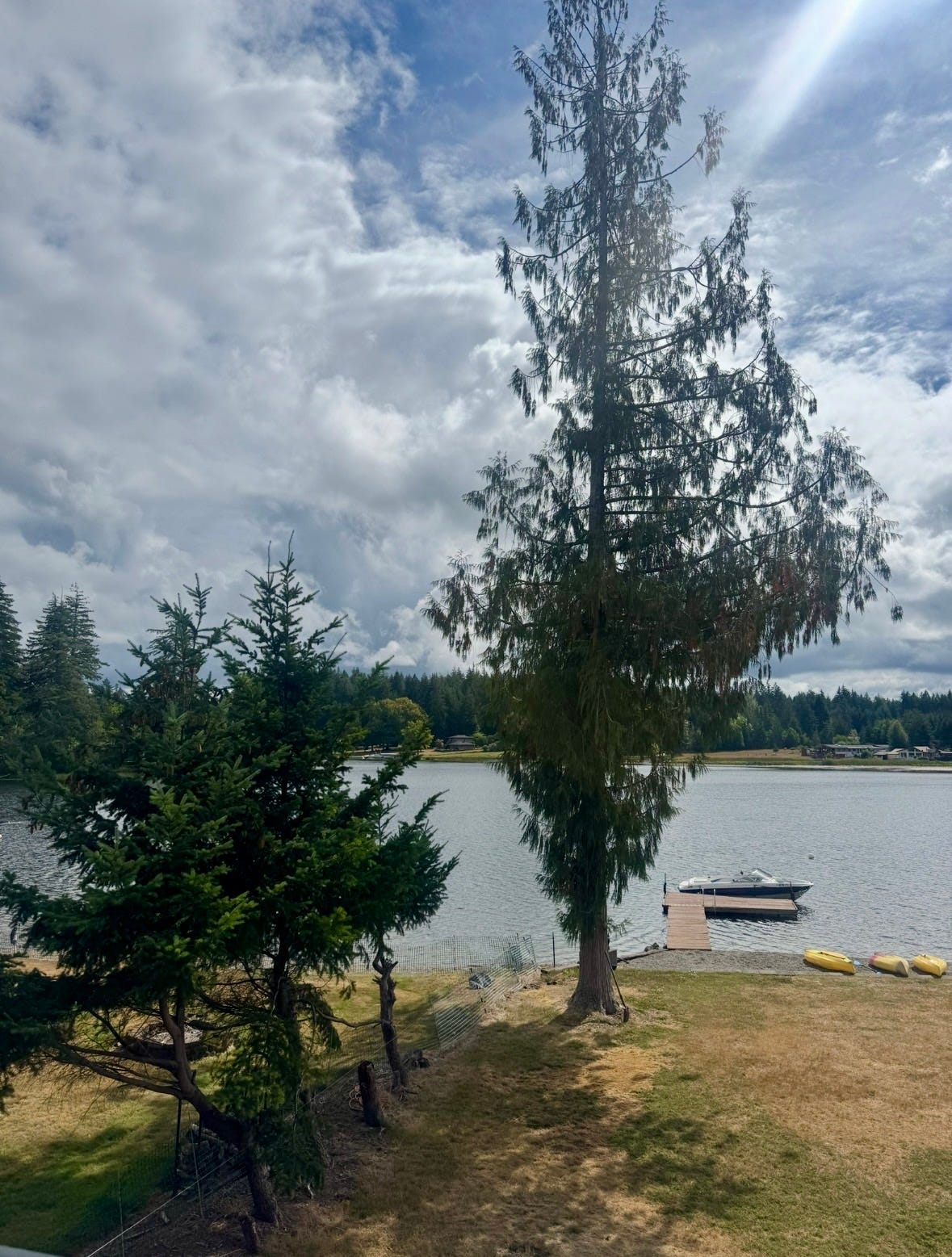
Apparently, there were not three trees. There were five.
I discovered this shortly after writing Part 1, which seemed like an unnecessarily efficient way for the trees to prove my point.
The two Douglas-firs I had finally stopped calling pines were actually four Douglas-firs. They had been standing there all along.
I simply had not seen them.
So I went back outside.
Not to make another assumption.
To look.
Sure enough, once I began paying closer attention, the differences became impossible to miss.
The Douglas-firs were different heights. Their branches grew in different shapes. Some were fuller than others. Some carried more cones. Some of their limbs were straight, while others twisted and bent in ways that looked almost misshapen.
Those were observations.
I saw what I saw.
Period.
And then I remembered the scars.
These trees stand along a property line. Over the years, branches that crossed too far onto this side were cut back with saws and axes. Not because the trees had done anything wrong, but because they had become inconvenient.
The evidence remains.
Missing limbs.
Old cuts.
Branches redirected around wounds they did not choose.
Suddenly I was not merely looking at the shape of a tree. I was looking at some of its history. And that changed the way I saw it.
The branch was still crooked.
The scar was still there.
Nothing about the original observation became false.
I simply knew more of the story.
That distinction is important.
Assumptions are not always built from things we imagined. Sometimes they are built from things we really did see.
The mistake comes when we take an observation and give it the authority of an explanation.
He spoke harshly.
True.
He is an angry man.
Not the same statement.
She walked away.
True.
She does not care.
That is something else entirely.
We move from what happened to who someone is with astonishing speed; and somewhere in that movement, punctuation changes.
A fact becomes a label.
A behavior becomes an identity. An assumption becomes a period.
We stop asking.
We stop listening.
We stop wondering what we do not know.
It is here where love has something to say.
Love does not deny what it sees. It simply refuses to believe that what it sees is all there is to see.
That does not mean wrong becomes right.
It does not mean hurtful behavior gets excused.
It does not mean discernment disappears.
It means love does not confuse a moment with a whole person.
Jesus said,
“Love one another. As I have loved you, so you must love one another.”
When I look at the way Jesus loved people, I notice how often He asked questions.
What are you seeking?
Do you want to be healed?
Who do you say that I am?
What do you want me to do for you?
Jesus was not short on understanding. Yet He still made room for people to answer.
He drew them out.
He encountered them.
Love moved toward them.
That is what love does.
It asks. It listens. It seeks clarity.
It makes room for the story behind what is immediately visible.
And that brought me back to another piece of punctuation.
But.
We use that word constantly.
I love you, but…
I am sorry, but…
I understand, but…
And so often everything before the but becomes weaker than everything after it.
The word has a way of erasing what came first.
But there is another word.
And.
And does not erase.
It allows two things to remain true at the same time.
You hurt me.
And I want to understand what happened.
What you did was wrong.
And I refuse to make that one action the entirety of who you are.
I see the scar.
And I know there is a story behind it.
Those branches were cut.
And the tree kept growing.
That last one matters to me.
Not because the cutting was good.
Not because the wound was necessary.
Not because the scar should be romanticized.
The tree did not need violence in order to become a Douglas-fir.
The branches were cut…
and life continued.
Both truths belong in the sentence.
Maybe that is one of love’s disciplines.
Not replacing truth.
Not softening truth.
Not denying what happened.
Adding what is also true.
Understanding does not always change what we see.
Sometimes it changes how we see it.
The branch remains crooked.
But now I know something about why.
The scar remains.
And now I know it was not chosen.
The person may still have spoken harshly.
And now I know there may be something I do not understand.
Fear, perhaps.
Grief.
Shame.
Exhaustion.
Or a story I have not been invited into yet.
Curiosity asks enough questions to move us toward understanding. Not endlessly. Not because every conclusion must remain suspended forever.
But because wisdom knows the difference between what we actually know and what we have supplied.
And love knows something else.
No person is a period.
No single failure contains an entire life.
No wound tells the whole story of the person carrying it.
No behavior, title, diagnosis, success, mistake, opinion, role, or reputation is large enough to hold a human being.
We are always more than the sentence someone else has written about us.
And we are always in danger of writing sentences about others that God has not finished.
That is why the question I asked the Holy Spirit in Part 1 keeps returning:
What is the question I have not asked?
It is no longer only a question about curiosity.
It is becoming a question about love.
What do I not know?
What have I assumed?
What story have I supplied?
What have I made final that is not final?
Where have I placed a period simply because I was tired of asking?
The trees beside our lake are still scarred. They are still uneven. They still grow differently.
And they are still growing.
I can see all of that now. Not with less truth, but with more of it.
That is what love does.
It does not look away from what is there.
It leans closer.
It asks.
It listens.
It makes room.
And instead of finishing someone else’s sentence too soon, it leaves space for an and.
So I will leave you with the question that started all of this:
What is the question you haven’t asked?
About God?
About someone else?
About yourself?
Where have you placed a period because you assumed you knew the whole story?
And where might love be asking you to replace it—not yet with another answer, but with a question mark?
Perhaps that question will leave room for an and.
⸻
© G. Wray. All rights reserved.
A wise and important essay. Reminds me of how Jesus warned us to take care of the log in our own eyes before thinking about the speck in someone else’s.
Well, I'm thankful the trees had more to say. So impactful and Godly reminders for each one of us as well as reflective within our own spirits. I love "and's". We are a never-ending story, some chapters hidden for another time, some ready to be read in the moment. Some wounds have healed and others in the process as well as old and fresh. This story reflects mercy and grace to be applied for all of us. Thank you.