

In Psalm 51, David does not simply ask to be forgiven.
He asks for hyssop.
“Purge me with hyssop, and I shall be clean.”
Hyssop.
A small plant.
Low to the ground.
Unimpressive.
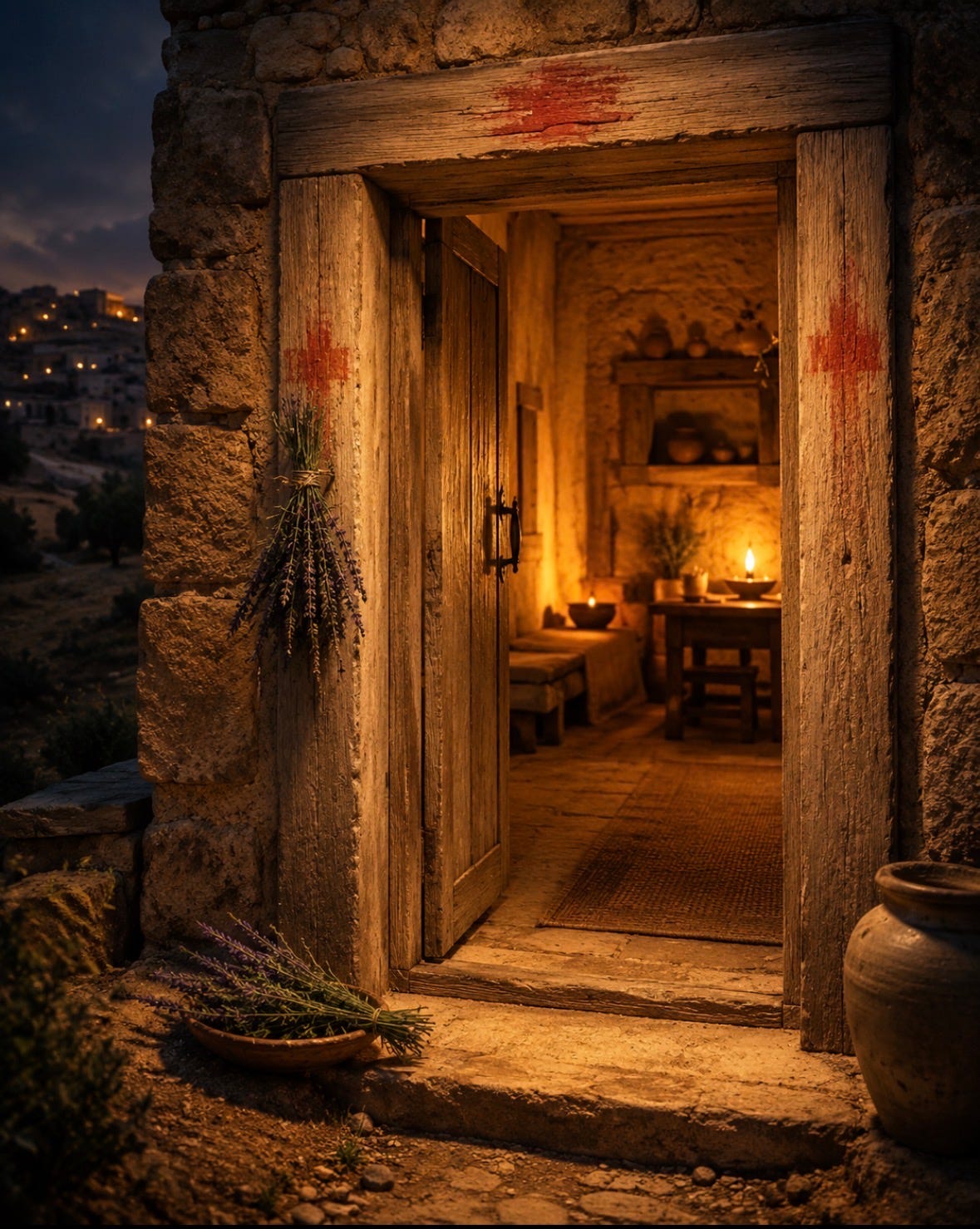
And yet at the first Passover in Exodus 12, hyssop was the instrument used to apply blood to the doorposts.
The lintel above.
The two posts on either side.
But never on the ground.
The blood was lifted—not laid where it could be trampled.
It marked the entrance above and around.
It declared belonging.
Those inside the house could not see the blood from within.
It was not given merely to steady their feelings.
It marked the household before the One who passed by in the night.
And it was God—not the household—who was said to look upon the blood.
The mark said:
This one belongs.
Their safety rested not on the steadiness of their feelings within the house, but on the covenant sign God had placed upon its doorway.
⸻
Hyssop appears again in the cleansing of a leper in Leviticus 14.
A leper lived outside the camp.
Cut off.
Untouchable.
Declared unclean.
When cleansing came, the priest would take cedar, scarlet, and hyssop, dip them in blood, and sprinkle the one who had been outside.
Hyssop marked the moment of re-entry.
It became one of Scripture’s quiet signs of restoration.
⸻
Now listen again to David.
After betrayal.
After misuse of power.
After crossing sacred boundaries.
He does not simply say, “I sinned.”
He reaches for the language of exile.
“Purge me with hyssop…”
He feels like someone who must stand outside the camp and cry, “Unclean.”
He feels contagious with guilt.
And beneath his confession is a quieter question:
Am I still Yours?
He is not only asking for cleansing.
He is asking to be brought back in.
To be marked for belonging again.
⸻
Hyssop was never the sacrifice.
It was the instrument that applied mercy.
David seems to ask God to do what was ordinarily entrusted to a priest: to come to his threshold, to take covenant blood, and to mark him again.
Not merely emotionally.
Not vaguely.
But covenantally.
To declare before heaven:
This one is Mine.
⸻
Centuries later, at another Passover, hyssop appears again in John 19.
This time, the blood will not be brushed onto wood by human hands.
It will flow from the Lamb Himself.
And Jesus has already said in John 10:9:
“I am the door.”
The doorway is no longer wood.
It is a Person.
The Cross becomes the threshold that remains marked.
Forever.
⸻
There is a verse in Hebrews 10:29 that has unsettled many tender hearts:
“…who has trampled underfoot the Son of God and regarded as unclean the blood of the covenant…”
Some read that and quietly fear:
What if I have done that?
What if I crossed too far?
But trampling is not stumbling.
Trampling is not grief over sin.
It is not longing for restoration.
It is not the cry, “Purge me with hyssop.”
It is hardened contempt.
And remember:
The blood at Passover was never placed on the ground.
It was lifted above the doorway—not laid beneath careless feet.
Hebrews borrows that covenant language to describe something far deeper—not accidental failure, but deliberate contempt for the blood of Christ.
If your heart still trembles toward the door,
if you still ache to be made clean,
that ache itself is not the mark of contempt.
Contempt turns away.
Sorrow still faces home.
⸻
The deepest ache beneath Psalm 51 is not merely:
“I have sinned.”
It is:
“I feel outside.”
And beneath that, the trembling question:
Am I still Yours?
The Cross answers.
The mark remains.
The covenant stands.
The doorway is not locked.
You are not standing at a barred gate.
You are standing before an open door.
Come in.
And breathe.
⸻
Thank you for reading.
If this met you in a tender place today, may you know that the doorway of Christ is still open to the one who turns toward home.
⸻
© Gilda Wray. All rights reserved.
A beautiful and meaningful reflection. Thank you!
Love it!