

“Do not rejoice that the spirits submit to you—rejoice that your names are written in heaven. At that moment Jesus, full of joy through the Holy Spirit, said, ‘I praise you, Father, Lord of heaven and earth…’”
— Luke 10:20–21
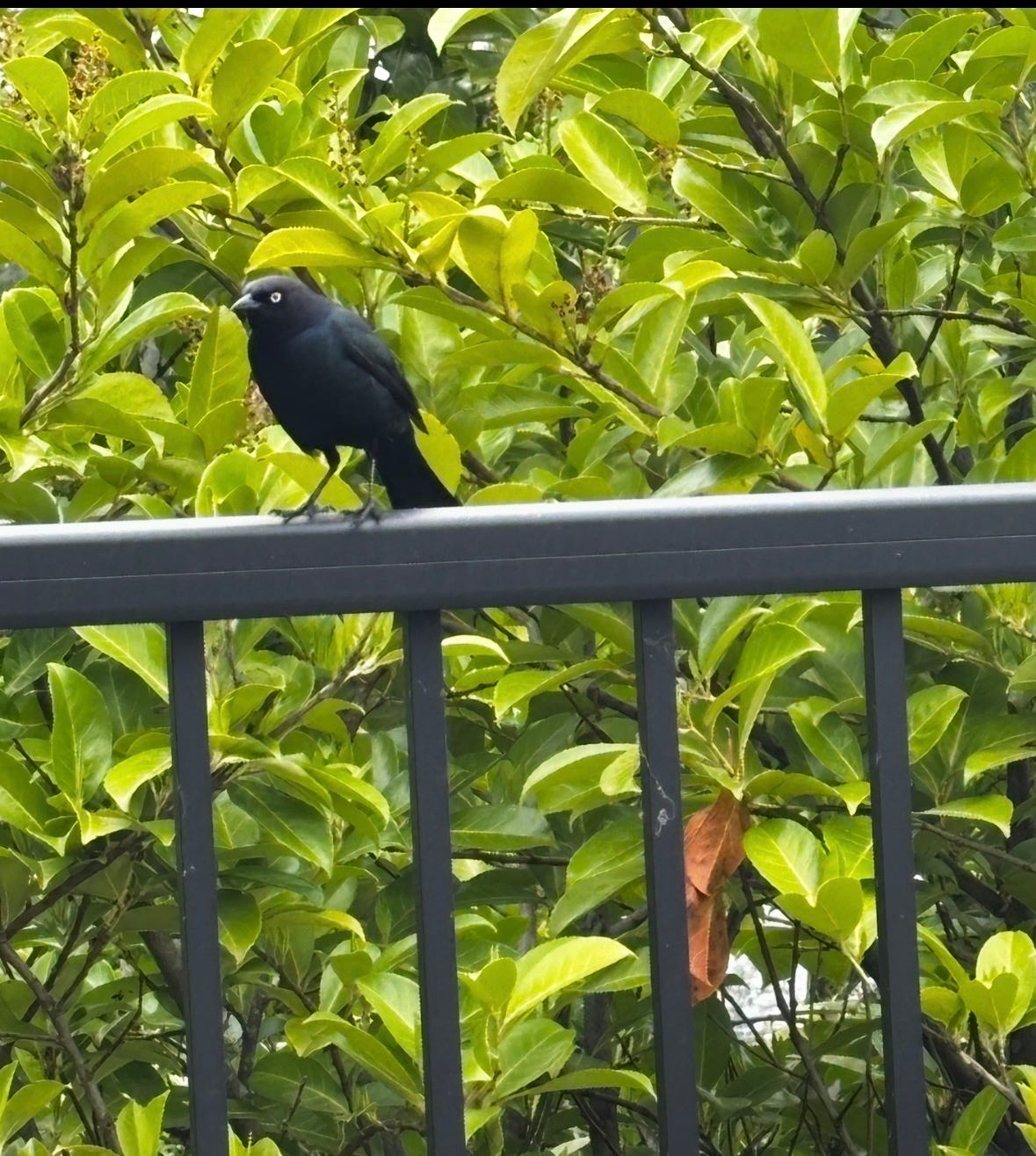
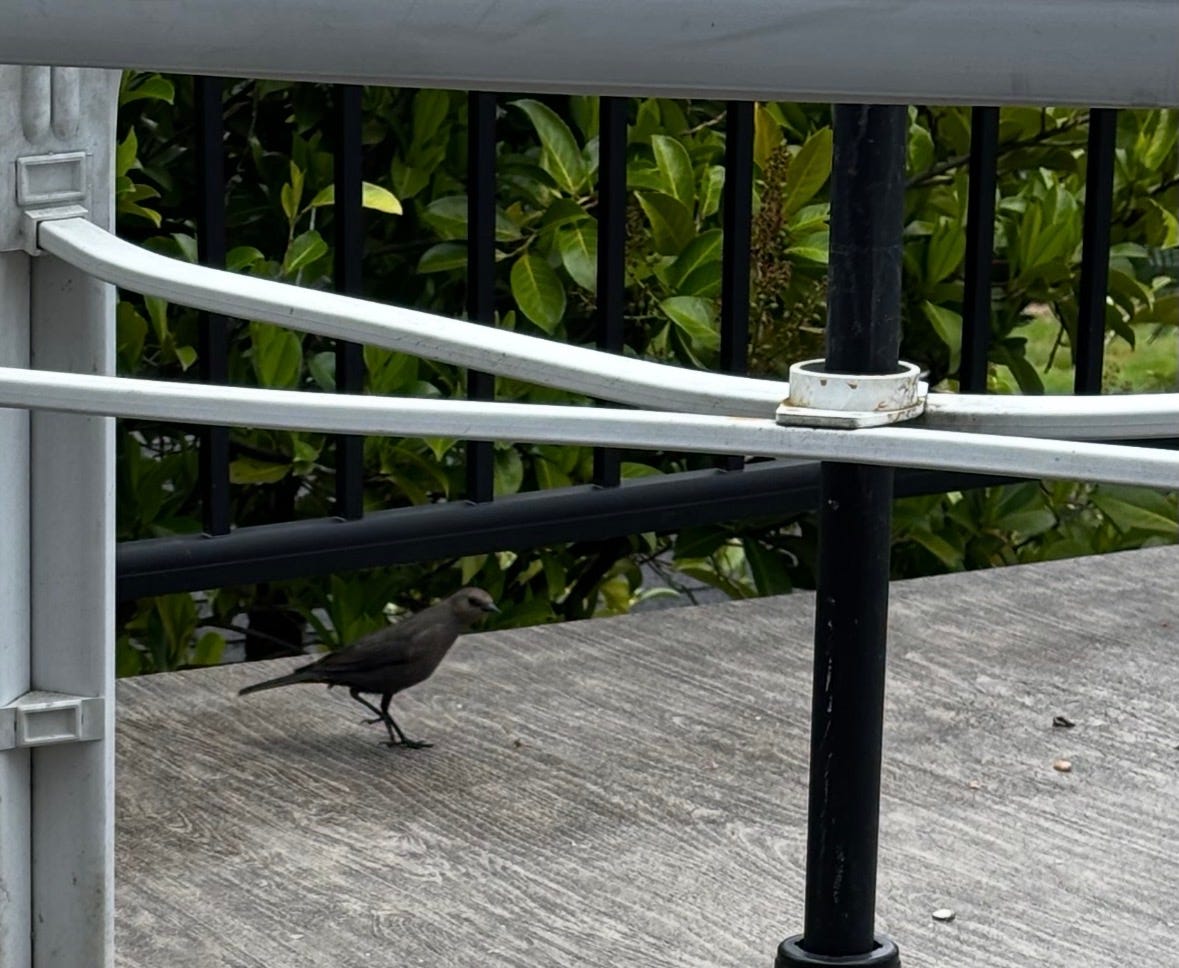
It started with a bird.
A small, plain brown one—dull as a December morning, picking her way across our deck with that quick, jerky confidence small birds carry like a secret. We barely noticed her at first.
Then my husband spotted the other one.
Glossy black. Perched on the railing above her like he owned the whole Pacific Northwest. And then it happened—he puffed. Every feather stood at attention. His tail fanned. His whole body quivered. A raspy, wheezy, magnificent pfft erupted from somewhere between his wings and whatever passes for a soul in a Brewer’s Blackbird.
“I think that bird has gas.”
“What? No—do you think something is wrong with it? Look at the poor thing!”
“I think it’s just… displaying?”
We watched a little longer, coffee in hand, heads tilted.
“Maybe that’s the female below him. Maybe he takes a big breath when he chirps and it ruffles all his back feathers like that?”
Silence. Then we both started laughing.
We had just watched one of nature’s most wholehearted love songs—and our first instinct was to call a vet.
But then something shifted.
We kept watching. And somewhere between the third pfft and the fifth full-body quiver, we stopped diagnosing him and started cheering for him. Silently willing that little brown female below to look up. To notice. To give him something—a glance, a hop in his direction, any small sign that all this magnificent effort was landing.
She kept foraging.
He kept singing.
And we kept watching, leaning forward now, two grown humans completely invested in the romantic prospects of a four-inch blackbird on a patio railing—whispering like it was the last five minutes of a film we couldn’t bear to end badly.
Come on. Look up. He’s giving everything he has.
And then—she flew.
Just like that. Off the railing, into the green, gone. And before we could even exhale, he was after her. Still calling. Still singing that raspy, wheezy, full-throated pfft into the morning air as he disappeared into the leaves.
He didn’t stop when the audience left. He didn’t collect himself or smooth his feathers and pretend the whole display had never happened. He just went—after her, still pouring it out, love and song and quivering feathers all the way into the trees.
We Have All Been Michal
My husband said it first, quietly, still watching the empty railing where the bird had been.
“You know… there we were, critiquing the little fella. Just like Michal when David was dancing.”
We looked at each other. And then we started laughing—really laughing—imagining it.
Michal, at the window. The procession still far off, a distant commotion of sound and movement. She leans forward, squinting. What on earth…? She can’t quite make him out yet. Is he ill? Has the heat gotten to him? Someone should really go check on him—
And then he gets closer.
And it dawns on her.
That’s her husband. The king. Her king—robes flying, leaping, spinning, absolutely beside himself with joy before the ark of the Lord. Not a fever. Not a fit. Just… David. Giving everything he has, holding nothing back, completely undone in the presence of the One he loves.
And something in her closes.
Maybe it was embarrassment. Maybe it was pride. Maybe she had simply forgotten—or never quite known—what it looked like when a person loved God with their whole body and didn’t care who was watching. Maybe she had never pfft-ed herself, never quivered, never fanned her feathers out and let the whole neighborhood hear about it.
But we wonder if beneath the embarrassment, something else flickered in Michal.
Envy.
Not the petty kind. The deep kind. The kind that rises when you watch someone experience something you have longed for and never found words to name. David wasn’t just dancing. He was moved. Something in him had been seized by joy so large his body couldn’t contain it—and it poured out through his feet, his arms, his voice, every undignified leaping inch of him.
The Spirit does that. When He moves, He moves the whole person.
And Michal was at the window.
Had she ever felt it? That holy urging rising from somewhere deeper than thought, the prompting that simply cannot be held in—that must express, must move, must sing? Had she ever been so full of God that stillness became impossible?
We don’t know. Scripture doesn’t tell us.
But we wonder if part of what hardened into contempt began as longing. If she had wanted, once, to be down there with him. To be that unguarded. That undone. To feel what he so clearly felt—and to let it show.
She was his wife. She had loved him once—fiercely, even. Scripture tells us so. She had risked her father’s wrath to save his life. She had chosen him.
And yet here was this whole interior world of his she could not enter. This place where the Spirit moved and David simply went—no hesitation, no self-consciousness, no thought for appearances or dignity or what others would think. He had access to something she couldn’t reach. A door she stood outside of, hands pressed to the lattice.
Why not me too?
That question, left unanswered long enough, does something to a person. It curdles. What begins as longing becomes distance, distance becomes resentment, resentment hardens into the kind of contempt that rises to the lips before we even know it’s there. By the time David comes through the door, flushed and joyful and still wanting to share it all with her—she has already closed.
The window became a wall.
And the saddest thing about a window is that it lets you see everything and feel nothing of the wind.
When Presence Draws Near, Things Leap
It is worth pausing over the joy-language Luke uses. The New Testament writers often wrote within the world of the Septuagint, the Greek Scriptures many of their hearers knew by heart. Their ears were tuned to echoes.
When the Septuagint describes David before the ark, it uses language of festive music and celebration before the Lord. The Hebrew beneath it gives the fuller bodily picture: David whirling, dancing, moving with all his might. Less a choreographed performance than a man being played like an instrument by the joy within him. Michal reacts so strongly because David is not performing dignity. He is overcome. The nearness of God has gotten into his feet.
Luke does not simply repeat David’s wording, but he does seem to gather that same scriptural world of embodied joy before the divine Presence. So when Mary—carrying Jesus—walks through Elizabeth’s door, the child in Elizabeth’s womb leaps. Luke uses σκιρτάω (skirtaō)—to leap, spring, or jump. Then Elizabeth says the child leaped ἐν ἀγαλλιάσει (en agalliasei)—in exultant joy.
And Luke keeps gathering that joy-language into a single stream. Mary says, “my spirit rejoices”—ἠγαλλίασεν (ēgalliasen)—in God my Savior. And later, Jesus Himself ἠγαλλιάσατο (ēgalliasato)—rejoiced, exulted—in the Holy Spirit.
David moves before the ark.
John leaps before the Lord Himself.
Mary rejoices in God her Savior.
Jesus erupts in Spirit-filled joy.
And the parallels Luke gives us are hard to miss.
David dances before the ark; John leaps before Jesus.
The ark travels to Judah; Mary travels to Judah.
David cries, “How can the ark of the Lord come to me?” Elizabeth cries, “Why is this granted to me, that the mother of my Lord should come to me?”
There is joyful sound around the ark, and Elizabeth lifts a loud, Spirit-filled cry.
Luke is making a staggering claim: Jesus is the true divine Presence the ark always pointed toward. And Mary—carrying Him—is, in this moment, a kind of living ark.
A first-century Jewish listener would have felt this resonance in their bones.
When Presence draws near—things leap.
They always have.
And so Luke 10:21 opens more deeply when we slow down long enough to feel it. Jesus ἠγαλλιάσατο (ēgalliasato)—rejoiced, exulted—in the Holy Spirit. The word carries overflowing gladness, joy that rises beyond mere inward feeling. Extravagant. Whole-bodied. A little undignified.
And what has moved Him to this? What has caused the Son to erupt in public, Spirit-filled joy?
Us.
Just before His joy rises, Jesus turns to the seventy who have returned breathless from the fields, buzzing with excitement over what they could do. The demons submitted! Look what we accomplished!
And He tenderly redirects them:
“Do not rejoice that the spirits submit to you—rejoice that your names are written in heaven.”
And then His joy erupts.
Not over their performance.
Not over their ministry results.
Over the irreducible, astonishing fact that they are known. That their names—ordinary, unhurried, sometimes confused, laughing-at-birds names—are written in the book of the Father.
He rejoices that the Father has hidden these things from the wise and learned and revealed them instead to little ones—to ordinary people. People with no impressive credentials, no polished framework, no perfected dignity—just open eyes and willing hearts.
People who sit on a deck with their coffee and watch a small black bird and wonder, what on earth is happening to him?
And then—slowly, wonderingly—begin to understand.
The whole Trinity, it seems, has a soft spot for people who lean forward at windows—as long as they’re willing, eventually, to come downstairs.
Michal stayed at the window.
The seventy came back from the fields, breathless and amazed, and Jesus rejoiced.
Do We Notice?
The bird is still out there in the trees somewhere. Still calling. Still giving everything he has to the morning air.
He didn’t earn his song. He didn’t perform his way into worth. He simply was what he was made to be—pouring it all out, held in his nature by the One who made him. One small creature doing what all creation has always done in the nearness of its Maker.
Leaping.
And your name—your actual name—is written in heaven.
Not because of what you’ve done. Not because your theology is tidy or your worship is dignified or you never once mistook a love song for a digestive complaint.
But because the Father knows you.
And that knowledge—that being-known—is what fills heaven with joy.
He exulted in joy over you.
The rejoicing is still happening.
Do we notice?
—
Thank you for reading!
Subscribe, comment, or share.
—
© Gilda Wray. All rights reserved.
Oh, the freedom of worship in all of God's creatures. Singing songs of love and adoration that open up our hearts to freely love and express our gratitude for our Father and lover of our souls. We all need to learn from the precious birds that sing their love songs not only to the Lord but to one another with full hearts and feathers fluttering and the sounds of pfft.