

A reflection on hidden fruit, holy patience, and the poem God is still writing
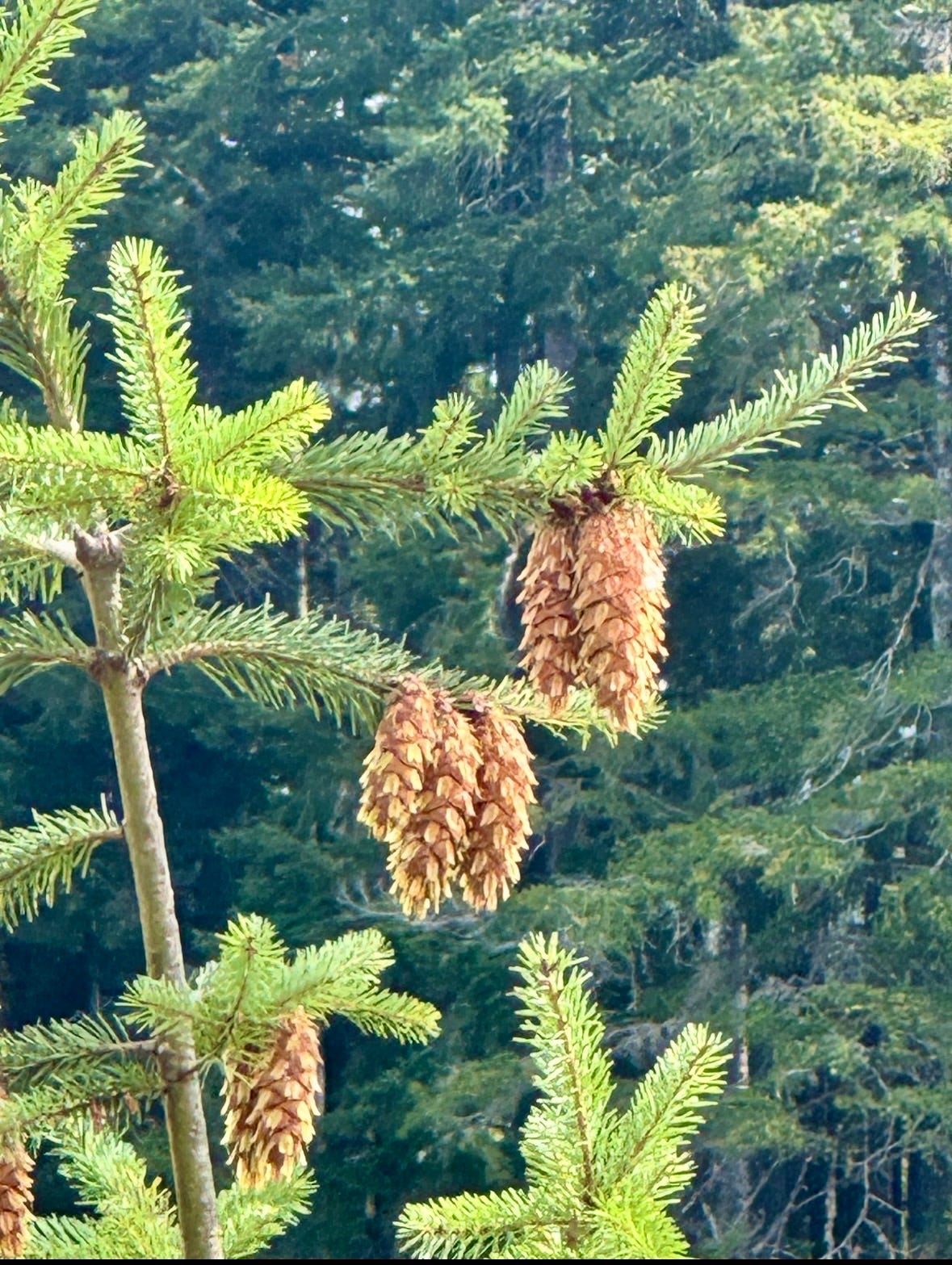
I have been watching the same Douglas fir for months now.
Not studying it, exactly. Watching it. The way you watch something you suspect is trying to tell you something, but you are not yet sure what.
It started with the cones.
They hang downward, not upward, the way I somehow expected fruit to hang. Single needles line the branches, not clustered the way some other conifers wear theirs. And the cones themselves are almost entirely near the top of the tree, on the newest growth, the branches still reaching upward into open light.
Nothing lower down. Nothing near the trunk, near the older wood, near what has been settled and secure on this tree for years.
Only at the reaching edges.
I did not expect that.
I suppose I imagined fruit belonging to the strongest, most established parts of a tree—the thick lower limbs, the ones that have survived every wind this tree has weathered.
Instead, the fruit was hanging from the newest, most exposed, least proven branches.
The parts still stretching.
The parts still, in some sense, vulnerable.
Fruitfulness, apparently, is not a reward for having arrived.
It happens at the growing edge.
A Poem Being Written
There is a word in Romans 1:20 I had never lingered over before this year.
Paul writes that God’s invisible qualities are understood through τὰ ποιήματα—ta poiēmata—the things that have been made.
The Greek word is poiēma.
It is the word behind our English poem.
Paul uses this exact word only one other time in his letters. In Ephesians 2:10, he tells us that we ourselves are God’s ποίημα—poiēma—His workmanship, His poem, still being written.
I did not expect a pinecone to remind me of that word.
But it did.
A poem is not something you solve. You do not read a poem once, extract its meaning, and set it down finished.
You enter it.
You sit inside its lines.
You return to it in a different season of your life and find it saying something you did not hear the first time—not because the poem changed, but because you did.
That is exactly how these months with this tree have felt.
I keep looking at the same cones, and they keep showing me something new. It is not because they are suddenly becoming something else, but because I am finally looking closely enough to see what was there all along.
The Bracts I Almost Missed
At first, the cones simply looked like cones—rounded, brown, papery scales overlapping like shingles.
It took several close, blurry photographs, and then finally one clear enough to trust, before I saw the bracts.
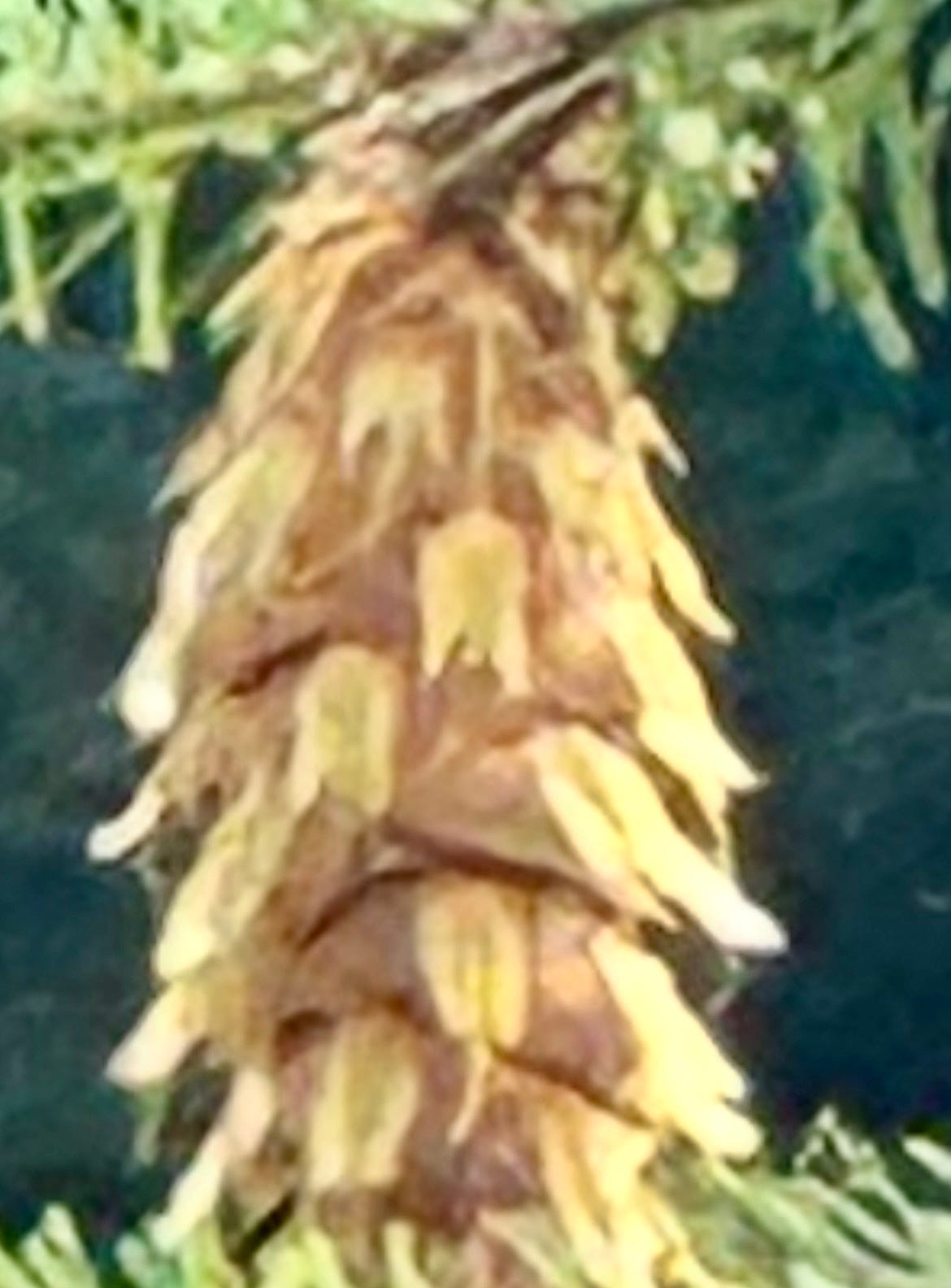
Tucked beneath each scale, easy to overlook from any distance, are small pointed structures, split into three—a longer central tip flanked by two shorter ones. Naturalists have long compared them to a mouse’s hind legs and tail, caught mid-dive into the cone. They are sometimes affectionately described as “mouse-tail” bracts, and they are one of the most recognizable features of a Douglas fir cone.
I do not think Scripture intends the number three here to mean anything in particular. I want to be careful with that. The bract’s three-pointed shape is a structural feature, not necessarily a coded message.
But I noticed something anyway.
And I want to hold it loosely, the way I hold the sycamine tree’s medicinal history or the sea’s ancient association with chaos in another reflection I wrote this year.
Not as proof; as resonance.
These small, three-part structures were there long before I saw them. They did not appear the day I finally noticed them. They were doing their quiet work—part of the structure surrounding and sheltering the developing seeds—the entire time I was looking at the cone and seeing nothing but a cone.
I wonder how often that is true of the way I am held.
Three-fold, hidden, structural, faithful—present and working long before I have eyes close enough, patient enough, humble enough to see it.
What Looks Finished Is Not Failing
In spring, these cones are tight, bright green, and closed.
They give away nothing yet.
As they mature, they dry and brown. Their scales open, and the seeds they have been carrying are released to wind and gravity, to whatever current will carry them away from the tree that made them.
A glance might read that browning as decline. Something that was green and living now dried out and spent.
But the browning was never the failure.
The browning was the arrival.
The cone was never trying to stay green.
It was trying to open.
Every stage of its color, every week of its drying, was moving toward this: releasing something it was never meant to keep.
Douglas fir seeds are winged. Many fall relatively near the tree that bore them; some are carried farther by the wind.
The tree does not extend its reach by holding on tighter.
Its reach depends upon letting go.
A cone that never opened could protect what it carried for a time. Though it could never send it anywhere.
I think I have sometimes lived like a cone that did not want to open. Holding what was only ever meant to be released. Mistaking the closed, green, protected stage for the whole purpose when perhaps it was preparation.
There is a time for holding.
Apparently, there is also a time for opening.
Fruit That Was Never for the Tree
I keep returning to where these cones grow: not near the root, not on the oldest wood, but at the branch tips reaching into the light.
Something about that unsettles my typical idea of fruitfulness.
The fruit is not ultimately for the branch that bears it.
The branch does not consume its own cone. The seed is meant to leave. The timing of the opening, the shape of the wing, the height at which the cone forms—all of it participates in sending something away from where it grew, toward ground the parent tree itself may never occupy.
That is a strange kind of fruitfulness to sit with.
The tree’s reproductive life is arranged around giving away what it grew, toward places it cannot follow, toward a future it will not live to see completely.
There is something else I had not understood.
The cone does not fall in order to release the seed.
It opens.
While it is still hanging there, its scales loosen and the winged seeds are released to the wind.
What the cone has spent a season forming and protecting leaves before the cone itself does.
Only later does the cone fall.
I found myself thinking about how much of a human life is like that.
We spend our years carrying things that were given to us and, somehow, entrusted to us to give again.
Love.
Faith.
Wisdom.
Mercy.
Words someone once spoke that took root in us.
Things taught at a table or learned beside a father. Things planted so deeply that sometimes we forget they came from somewhere before us.
There is a season for holding them close while they form.
Then there is a season for opening our hands.
Some of what God grows in us may travel farther than we ever will.
The cone eventually falls.
But by then, what it carried is already on the wind.
And even what falls is not wasted.
On the forest floor, the cone enters another work. It weathers. It breaks down. It becomes part of the litter and organic matter from which the life of the forest continues.
That is part of fruitfulness too.
Part of this process is growing something.
Another part entails carrying it.
Another part of the process includes giving it away.
And then, finally, in giving even ourselves back.
I do not think this is only botany.
Sitting and Puzzling
I asked, months ago, watching the first green cones tighten against the branch, what invisible thing God might be revealing here.
I am not sure I have the full answer yet. I am not sure a poem ever gives you the full answer. That may be the nature of poems, and the nature of this kind of looking too. Yet here is what these months have shown me so far.
Fruit tends to grow at the reaching edge, not the settled center.
What looks like drying up may sometimes be the arrival of purpose, not the failure of it.
The structures that hold things together are frequently hidden, faithful, and utterly unconcerned with whether I ever notice them.
And the fruit was never meant to remain on the branch that grew it. What has been carried and protected eventually has to be released, because some things are meant to travel farther than the one who carried them ever will.
I do not know yet whether I am finished watching this tree.
Sometimes it feels as though the poem has more lines left before I will understand its ending—if it ever fully resolves at all.
This may be the real work of a poem like this one.
It does not hand me an answer, but it seems to ask me the oldest question God ever asked a hiding man beneath the trees.
Ayekkah.
Where are you?
It is not because He does not know,
but because I need to be the one who answers it out loud,
and finds myself already found.
⸻
Questions for Reflection
What in your own life right now feels as though it is still at the reaching edge rather than the settled center—still exposed, still unproven, and yet apparently exactly where fruit is forming?
Is there something in you currently green and closed, not yet ready to open, that you have been mistaking for stillness rather than preparation?
Is there something you have been holding because letting it go feels like loss, when this tree has spent weeks quietly insisting that letting go is not the failure, but part of the purpose?
⸻
Thank you for reading. If this reflection held meaning for you, consider re-stacking or sharing it with others.
⸻
© Gilda Wray. All rights reserved.
Love the insight about fruit growing at the reaching edge, not the settled center. We can’t just remain stagnant in what we think we know!
This is really good, thank you for sharing this with us!