

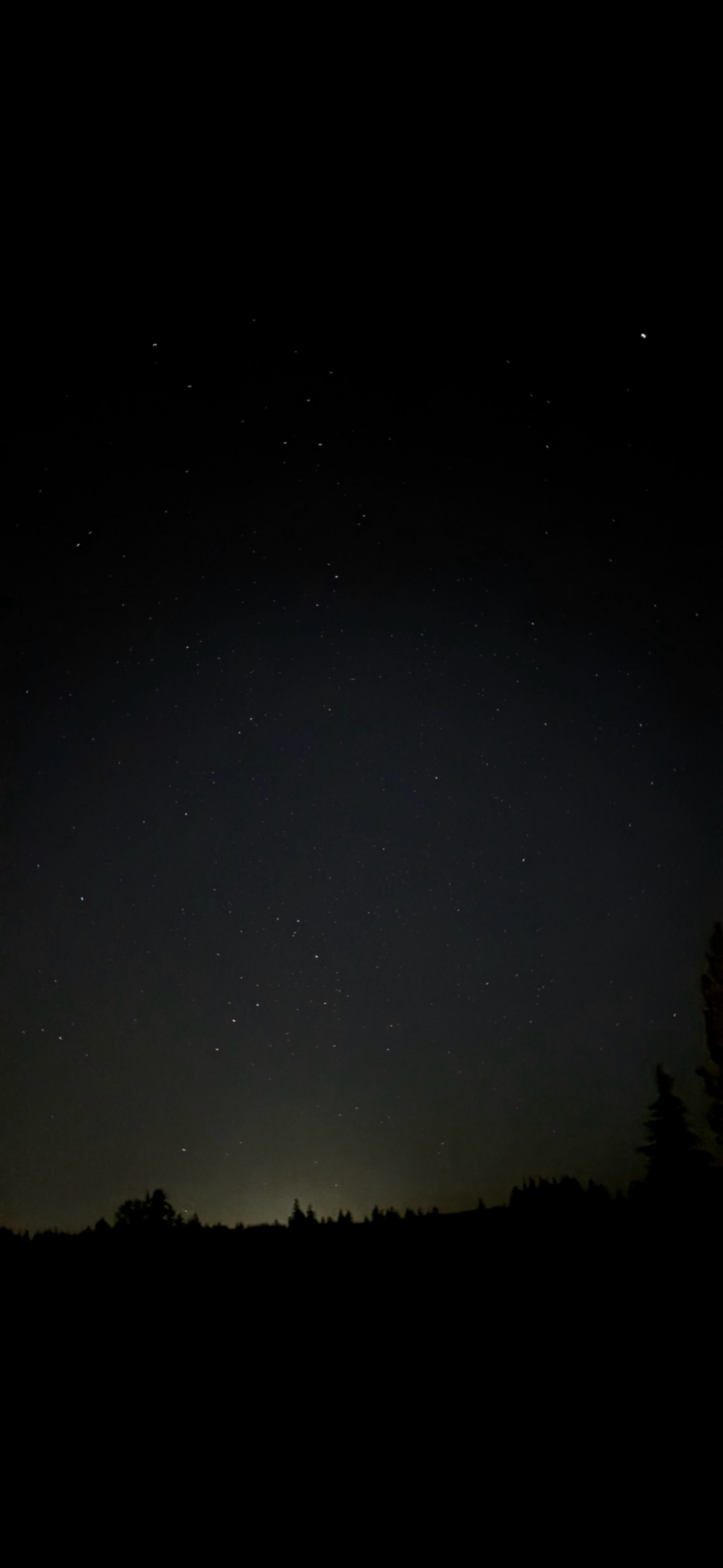
Tonight, the lights went out.
There was no warning. One moment the house was carrying on as houses do in the evening, quietly humming around us, and the next everything stopped.
The refrigerator fell silent. The familiar little lights disappeared. Outside, the darkness seemed to deepen all at once.
At first, we wondered if it was only us. We cannot see many of our neighbors’ homes from where we live, so there was no row of darkened houses to answer the question. We checked what we could and eventually learned that the outage stretched beyond our home.
There had been an accident.
A car had struck a power pole, and the electricity had been shut off while crews worked.
Suddenly, having no power seemed terribly insignificant.
Somewhere nearby were people whose evening had been interrupted by far more than darkness. There were families who might be waiting for news. First responders were tending to people they had never met. Men and women were working beside a dark road, doing the difficult work of helping others while carrying sights and stories most of us will never have to see.
So we prayed for them.
And then there was nothing much left to do. It was nighttime, after all.
I found myself thinking how strange it is that we have become so accustomed to pushing back the dark. For most of human history, when evening came, the day really did end.
People gathered closer.
The light itself required it.
A candle, an oil lamp, the fading glow of a fire—whatever light remained could illuminate only so much. As the light diminished, the circle grew smaller.
And that was not altogether a loss.
People gathered within that little circumference of light and gave one another something we rarely give without interruption anymore: shared attention.
They talked about what the day had brought. Someone remembered an old story. Tomorrow’s work was discussed and planned. Maybe a voice began singing and, one by one, the others joined in.
There wasn’t enough light to keep the whole world going.
So the world became, for a little while, the faces gathered near.
And then they rested.
They did not need to make morning come. They knew it would.
There was something almost forgotten in that thought—that darkness did not always mean something had gone wrong. Sometimes darkness simply meant the day was finished.
Not every darkness needs to be conquered.
Some darkness is an invitation to draw close.
As I sat there thinking about it, an old memory began making its way back to me.
I was a little girl again, lying beneath the stars beside my father.
Suddenly I remembered what I once believed all those lights were.
When I was very young, I thought people’s eyes were windows.
Not in the way we sometimes speak of eyes as windows to the soul. I knew nothing about metaphors or any of the things adults might use to explain such an idea.
I simply thought they were windows.
I believed there was a place inside each person where the truest part of them lived, and if I looked carefully enough into their eyes, I could sometimes tell whether that person wanted to come out and meet me.
If my father suggested I go ask another child to play, I would look first. Sometimes I could see the light there, and I knew it was all right to approach.
Other times I would tell him, “Not now. Her curtains are still closed.”
To me, that did not mean she didn’t like me. It only meant she wanted to stay inside a little longer.
Then one day at school I learned that these beautiful windows had a name.
Pupils.
I was terribly disappointed.
Pupils?
It seemed such an ordinary word for something so wonderful. A pupil was a student. Someone who sat at a desk and learned things. Why would anyone give such a boring name to the little windows through which people looked out at one another?
I went home and complained to my father. Why couldn’t they just change the word?
He smiled and told me to think upon it while we did our chores, and that we would come back to the question afterward.
Later, as we were walking back toward the house, he asked me, “So. Do you still want to change the word pupils?”
I had decided that changing it would probably confuse too many people. But I had also found a way to make peace with it.
“Well,” I told him, “I guess they are windows that teach us whether someone wants to play or hide.”
My father laughed.
And the pupils were allowed to keep their name.
It was because I understood eyes this way that the stars made perfect sense to me.
My father and I sometimes lay beneath them together. He knew their names and would point them out, telling me stories about the lights scattered across the darkness above us.
I loved those nights.
Somewhere along the way, I decided I understood what the stars really were.
They were God’s windows.
Of course He had far more than two. There were so many people in the world, and God had so many children to watch over. He needed lots and lots of windows so He could see all of us at the same time.
But I thought there was another reason for all those lights.
God wanted His children to know He was there.
He kept His windows open and His lights burning because He was always awake, always watching over us, always ready to come out and play.
One night, lying beneath those lights with my father, I explained all of this to him. I told him how wonderful I thought it was that God always left His windows open and His lights on so His children wouldn’t be afraid in the dark.
My father asked me what I meant.
So I explained about the eyes. People only had two windows, I told him, because we were only one person. But God had lots and lots of children and could see every one of us at once, so naturally He had lots and lots of eyes.
Then another thought occurred to me.
“Isn’t this how you learned to leave a night-light on in my room too?”
My father didn’t answer.
He just kissed the top of my head.
There was, however, a small problem with my theory.
Science class.
One day my teacher explained what stars actually were.
Gas.
I was confused.
When she asked a question about the stars, I answered according to what seemed perfectly obvious to me: they were windows, and God kept the lights on.
This did not go particularly well.
I got in trouble.
Maybe my teacher thought I was being rude. I was genuinely confused. Why was she upset with me? I wasn’t trying to be difficult. I had simply answered according to what I could see.
That evening I told my father what had happened. He listened with the hint of a smirk on his face.
“Well,” he asked, “what do you think about it now?”
I had already given the matter considerable thought.
I told him I had decided that both things could be true. Grandma had told me about the gaslights they had when she was growing up. So gas must simply be how God had decided to light His windows.
My father laughed.
“Well, look at that!”
And as far as I was concerned, the matter was settled.
The stars could be made of gas.
They could still be windows.
I grew older, of course. I learned what stars really are. I learned that pupils are not windows and that no tiny person lives somewhere behind them waiting to come out and play.
But I never entirely stopped seeing either one the way I had as a child.
Even now, I find myself looking into people’s eyes before approaching them. I still notice when the light seems open and when the curtains seem drawn.
Most nights, I still look at the stars.
I know what they are.
And I still thank God for leaving His lights on.
Tonight, sitting in a darkened house, I told this story again. And then I learned something I wish I could have carried back to that little girl who was so disappointed to discover that her windows were called pupils.
The word isn’t nearly as boring as she thought.
The word pupil, for the dark center of the eye, comes from the Latin pupilla—“little girl” or “little doll”—a name connected to the tiny reflected figure seen when we look closely into another person’s eye.
Scripture contains an image remarkably like it.
Where our English Bibles often say “the apple of his eye,” Deuteronomy 32:10 uses a Hebrew expression commonly understood as “the little man of his eye”—evoking that tiny human figure reflected in another person’s gaze.
I sat with that for a moment.
All those years ago, I had gone off to do my chores and eventually decided that the name could stay. If pupils were students, then maybe eyes were windows that taught us something about the person inside.
It turns out I had the reason for the name all wrong.
Yet the old word held a wonder of its own.
People had been looking into one another’s eyes for a very long time and seeing a tiny person there.
I wish I could tell my father.
I think he would smile that same smile and say,
“Well, look at that.”
This may be one of the gifts of growing older.
We do not always have to choose between knowing more and wondering less.
Sometimes what we learn does not close the window.
Sometimes it opens it wider.
Tonight, our lights are still out.
Somewhere not far from here, people are dealing with the aftermath of an accident. I do not know who they are or what this night has brought them.
So I pray for them.
I pray for their families, for the first responders who went toward the suffering when everyone else’s instinct would be to turn away, and for the people working along a dark road, repairing what was broken so hundreds of homes can have their ordinary evening returned to them.
And then I look around our quiet house.
Earlier, I had imagined those small circles of light and the people gathered within them.
The day’s work had ended because the light had ended. As the room darkened, the circle drew closer. They shared what the day had brought and spoke of what tomorrow might require. They listened to one another. Maybe someone sang.
Their attention gathered where their bodies had gathered.
When there was nothing more to be done, they rested.
They did not stay awake to make certain the sun came up.
They trusted the dawn to arrive without their help.
We have gained so much by being able to push back the darkness. I am grateful for electricity, and I will certainly be grateful when ours returns.
But in illuminating every corner of our nights, I wonder if we have lost something precious too.
We can keep working. Keep watching. Keep reading. Keep scrolling. We can sit beside one another while our attention wanders into entirely different worlds.
We have learned how to keep the day going.
Have we forgotten how to let it end?
Tonight has reminded me that we can choose differently.
We can still draw close.
We can still gather our attention where we have gathered ourselves.
We can tell one another what the day has brought. We can speak of tomorrow. We can listen. We can sing. We can pray.
And when there is nothing more for us to do, we can rest.
Because there is One who does not.
He who keeps you will not slumber.
Behold, he who keeps Israel will neither slumber nor sleep.
—Psalm 121:3–4
I knew something of that long before I knew the Psalm.
As a child, I was not a very good sleeper. I would lie awake at night imagining that my father must be keeping watch over the house. In my child’s mind, I decided I should stay awake too. I didn’t want him to have to keep watch alone.
Then, sometime in the early morning, I would hear the faucet running.
I knew that sound.
My father was up. He was shaving. Morning had come.
Something inside me would grow warm and finally loosen.
My father was awake.
I could sleep.
Perhaps that is why the stars comforted me so much.
God was awake too.
His windows were open.
His lights were on.
And because they were, His children did not need to be afraid of the dark.
All these years later, I still look at the stars most nights. I know now what they are.
But somehow, I have never stopped seeing the windows.
I still thank God for leaving His lights on.
Tonight, more than most nights, I am grateful for them.
The earthly lights around me have gone dark, and somewhere beyond this house there is suffering I cannot see and cannot mend.
But above me, the old lights are burning.
And I remember.
Father is awake.
His children may draw close.
His children may rest.
We do not have to stay awake to bring the morning.
The dawn is His to give.
And it is not far.
Tonight, our lights may be out.
But His are still on.
——
©️ Gilda Wray. All rights reserved.
Lovely friend. I think God smiles upon the slightly confused stories of faith we imagine when we are small when they are still making Him the hero.
This spoke to me. I truly enjoyed reading a about your relationship with your father.