

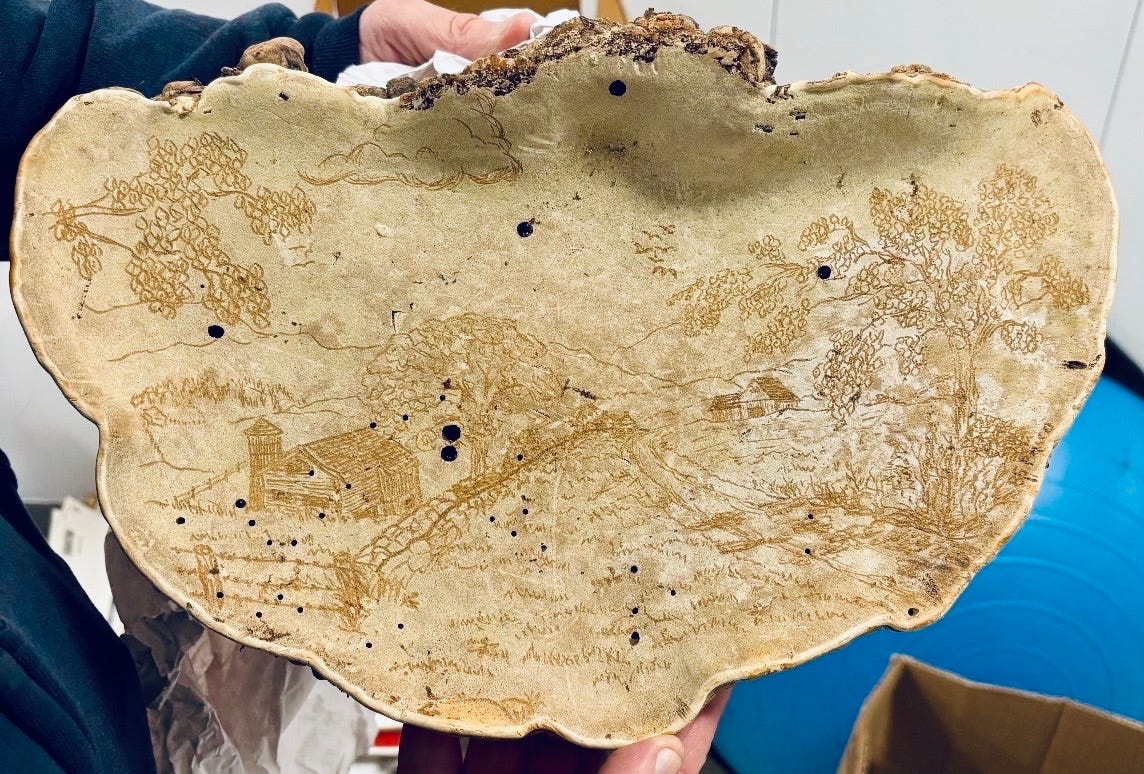
My father could draw almost anywhere.
He did not need a studio, a proper table, or even a pencil. Give him a quiet patch of forest, a nail, and one of the great shelf mushrooms that had completed its life upon a tree and fallen naturally to the ground, and he had everything he needed.
He never took them from the tree while they were still growing.
That mattered to him.
The forest had to finish with them first.
Only then would he lift one carefully, turn its pale underside toward the light, and study the surface as if it had already whispered what it wished to become.
I loved watching him.
The nail would move slowly across the mushroom, leaving fine brown lines wherever its point passed. At first, I could not tell what he was drawing. A curve became a hill. A few angled strokes became the roof of a barn. A darkened rectangle opened into a doorway. Trees began rising at the edges, each leaf patiently etched into place. Stone walls wandered through the scene, fields rolled toward distant mountains, and clouds gathered quietly overhead.
Nothing was hurried.
The surface was uneven, marked by the small holes and imperfections that belonged to its life in the forest. My father never tried to disguise them. He drew around them and sometimes seemed to let them become part of the landscape. The mushroom was not merely his canvas. It became his collaborator.
For my sixteenth birthday, he made one especially for me.
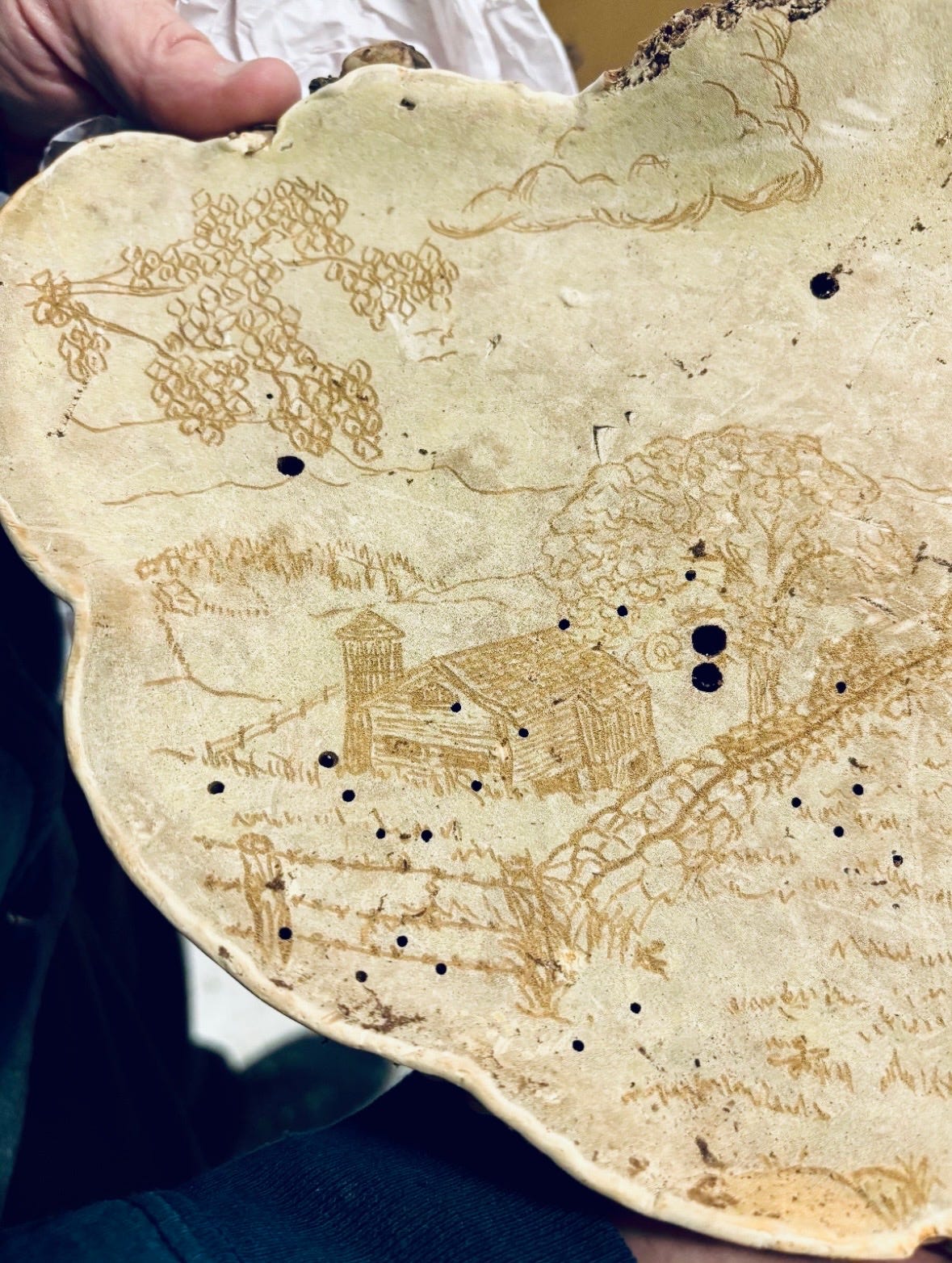
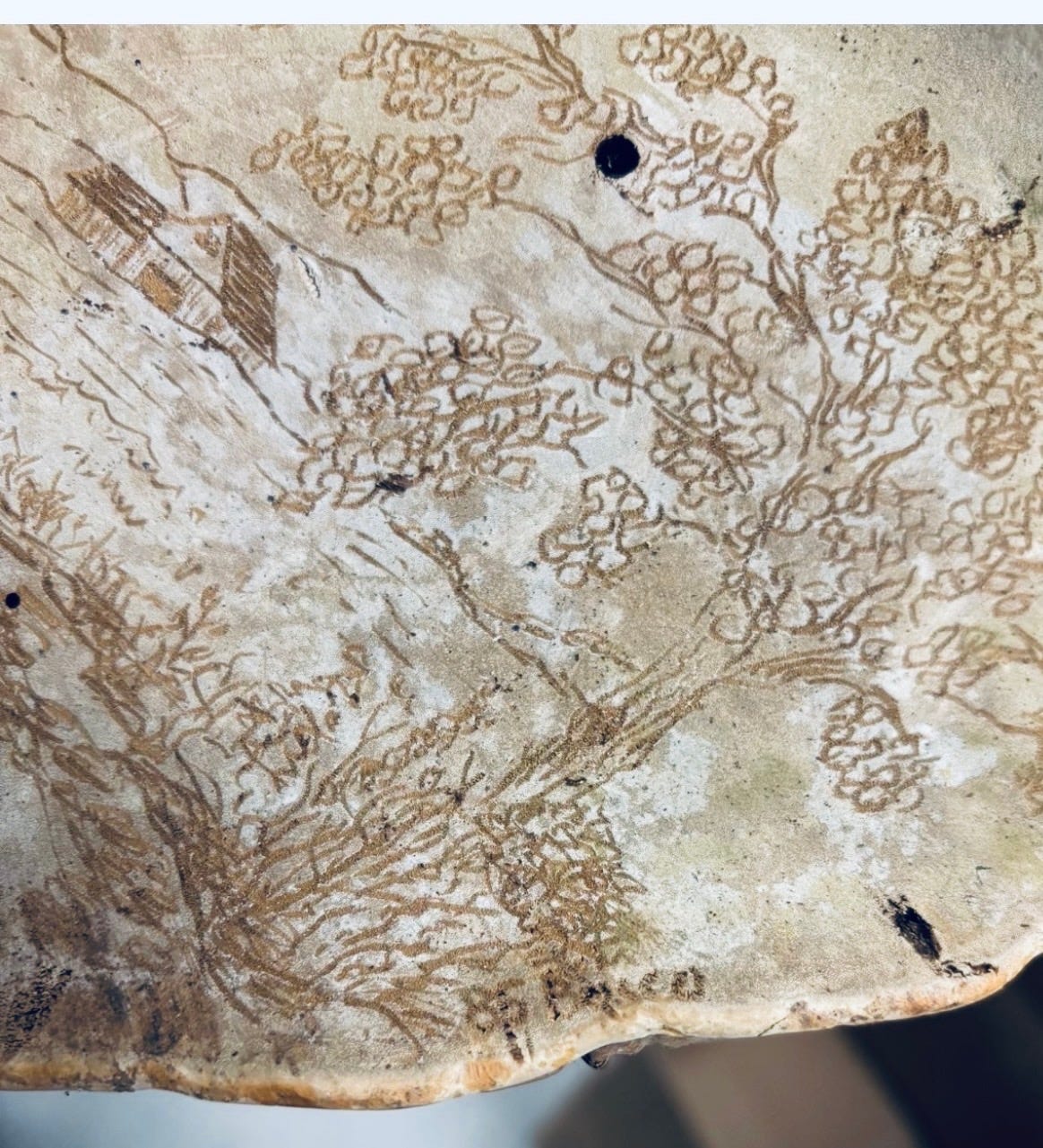
Across its broad underside, he etched a world: a cabin settled beneath trees, a winding stone wall, fields, distant hills, great branches stretching protectively across the sky. He made it with nothing more than a nail, yet the smallest details remained—the boards of the buildings, the leaves clustered along every branch, the grasses bending beside the wall.
I thought it was magnificent.
He called it doodling.
I tried many times to convince him to show his mushroom sketches at craft fairs. I imagined people gathering around them in amazement, finally seeing what I had always seen—that my father was an extraordinary artist.
He always refused.
“No,” he said. “Then everyone will try to make them.”
At first, I thought that was the point.
But he continued.
“They’ll traipse through the woods and tear them off the trees before they’re ready. They won’t wait for them to fall. The forest will suffer.”
There it was.
Reverence.
He would not trade the well-being of the forest for admiration. He would not turn something freely offered into something taken. His art began only after the mushroom had completed its purpose and the tree had released it.
He did not believe that loving something gave us permission to possess it.
Love waited.
Love watched.
Love received what was given.
That was how he entered the forest—not as an owner inspecting what belonged to him, but as a guest among living things. He stepped lightly. He noticed what had fallen. He used what the land had finished with and left the growing things undisturbed.
Most artists protect their creations.
My father protected the source from which creation came.
I kept that mushroom on a special table everywhere I lived. Through every move and every changing season of my life, it traveled with me. Its surface aged. The colors softened. Small marks appeared with time. But the scene remained: the trees, the house, the stone wall, the distant hills—all held within something that once grew quietly from a tree in our forest.
I treasured it because he made it for me.
But I treasure it now for another reason.
It carries the shape of his conscience.
Every line says that beauty should not wound what gives it life. Every tree he etched reminds me that creation is not raw material awaiting our ambition. It is gift. It has rhythms and seasons of its own. It must be approached with patience.
My father could have made many of these.
He could have sold them.
He could have been praised.
Instead, he made only what the forest freely placed into his hands, and he gave them quietly to people he loved.
That was his artistry.
That was his stewardship.
That was his reverence.
Reflection
What the Forest Freely Gives
We often believe appreciation must lead to possession.
We see something beautiful and immediately want to take it, display it, reproduce it, or make it ours. We call this admiration, though sometimes it is only appetite wearing a gentler name.
My father taught me another way.
He taught me to wait until the forest had finished.
To receive rather than seize.
To let beauty remain where it belongs until it is freely released.
Reverence is not passive admiration. It is love with restraint. It is wonder disciplined by care. It asks not only, What can I make from this? but also, What might be harmed by my taking it?
The mushroom sketches were beautiful because of his talent, but they were sacred because of his patience.
He knew that not every gift should become a market.
Not every discovery needs an audience.
Not every beautiful thing must be multiplied.
Some things are meant to remain rare because rarity protects the quiet life from which they came.
The sketch he made for my sixteenth birthday still rests near me. A whole forest world held upon a fallen mushroom, drawn with a common nail by a man who insisted he was not an artist.
But when I look at it now, I see more than the scene he etched.
I see him kneeling beneath the trees.
I see his careful hands.
I see the reverence written across his face.
And I remember:
The finest art does not merely portray beauty.
It teaches us how to love beauty without destroying it.
©️ Gilda Wray. All rights reserved.
Thank you for sharing this. My grandfather wasn't an artist, but he lived in the forest and had special reverence for all its gifts.
What a beautiful insight into your father and how proud he would be of you. I could so identify with this as there are times that a gift given to us by our Father in Heaven, is not to share in a monetary way but to be given as a gift as it was to the original receiver. When we can recognize that this is our purpose we receive back double fold.