

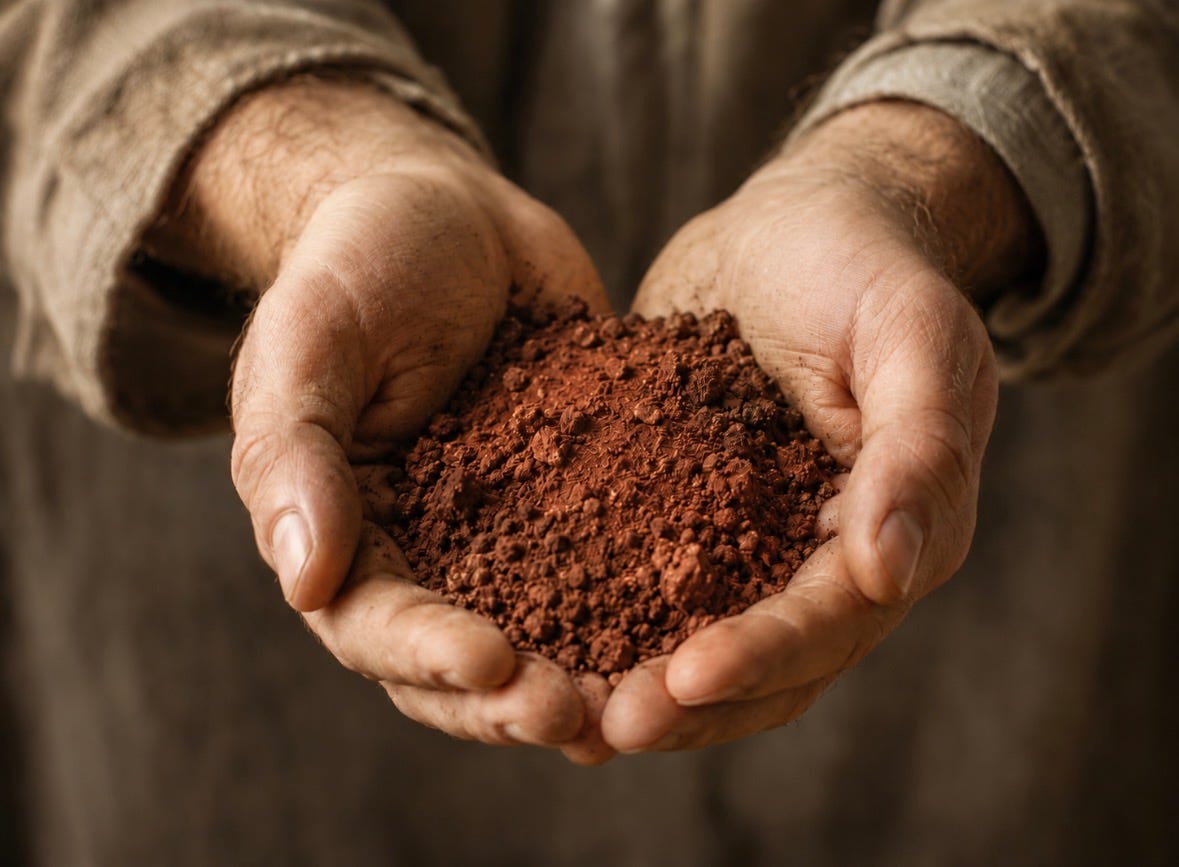
There is something quietly beautiful about watching someone kneel.
Parents do it without thinking.
Gardeners do it every day.
They stoop toward what is small.
Toward what others hurry past.
Toward what needs tending.
The Bible begins with a God who does the same.
He stoops.
He gathers dust from the ground.
Then He breathes.
And dust becomes a living soul.
From the very beginning, our Creator has not been afraid to come near what is lowly.
It should not surprise us.
Love has always been willing to stoop.
⸻
I found myself reading one of the strangest passages in all of Scripture.
It spoke of a red heifer.
Not a lamb.
Not a goat.
A red heifer.
She was led outside the camp.
Given wholly.
Consumed completely by fire.
Then came the detail that made me pause.
God did not tell His people to sweep the ashes away.
He told them to gather them.
Carefully.
Why?
⸻
The more I lingered, the more I began to wonder whether this ceremony was quietly echoing something older.
The Hebrew word describing the heifer as red belongs to the same family of words as Adam and the ground from which humanity was formed.
How far that echo is meant to reach, I cannot say.
Yet the language itself seems to invite us to wonder.
Formed from the earth.
Returning to the earth.
And yet even there…
God was not finished with the dust.
We sweep dust away.
God gathers it.
⸻
One detail has never stopped amazing me.
The people who prepared the ashes became ceremonially unclean.
The one who burned the sacrifice.
The one who gathered the ashes.
Even the one who later sprinkled the water.
Yet those who came burdened by death were made clean.
I have often wondered if the whole ceremony was quietly teaching Israel something.
Sometimes love bears another’s burden.
Sometimes the one who comes near carries what another cannot.
⸻
Death leaves its mark upon all of us.
Not only when someone we love dies.
There are losses that leave their own kind of dust.
A broken friendship.
A dream quietly laid to rest.
A diagnosis.
A season we cannot return to.
Scripture understood something we often try to outrun.
Death is never merely an event.
It leaves traces.
It settles over things.
It lingers.
It touches more than we wish it would.
And so God asked His people to do something astonishing.
Gather the ashes.
Do not discard them.
Mix them with living water.
Life met what death had left behind.
Ashes quietly testify that the fire has already done its work.
Nothing more remains to be consumed.
I cannot help wondering if that has always been God’s way.
Not denying death.
Not pretending it never happened.
But meeting it with life.
⸻
Centuries later, another sacrifice would take place outside the city.
Given wholly.
Holding nothing back.
The writer of Hebrews remembers the ashes of the red heifer,
then quietly says something astonishing.
If the ashes of a heifer could cleanse those touched by death,
how much more shall the blood of Christ cleanse our conscience to serve the living God?
The ceremony had always been pointing beyond itself.
Toward the One who would willingly bear our uncleanness,
so that we might stand clean before God.
⸻
Perhaps that is why Jesus was never afraid to touch the dead.
The widow’s son.
Jairus’ daughter.
Lazarus.
According to the Law, death should have spread its uncleanness.
Instead…
life spread.
Everything had begun to reverse.
Death was no longer contagious.
Life was.
Death still came.
Grief was still real.
But death no longer had the final touch.
Life did.
⸻
The Bible begins with a God who stoops in the dust.
It ends with a city where death is no more.
In between stands a cross,
an empty tomb,
and a Gardener whom Mary mistakes for exactly who He had always been.
Perhaps that was no mistake at all.
Gardeners kneel.
They gather.
They tend what seems lifeless.
They patiently care for what others overlook.
The risen Christ was doing what He had always done.
Coming near.
The Creator had returned to His garden.
Still stooping.
Still gathering.
Still coming near.
Still breathing life where death had spoken.
Still making all things new.
Perhaps that has always been the posture of love.
We spend much of our lives sweeping dust away.
God never does.
He stoops.
He gathers it.
Because in the hands of the Creator,
dust is never the end of the story.
⸻
Thank you for walking with me.
Has there been a place in Scripture where you caught a glimpse of the Father stooping toward what the world had given up on?
I’d love to hear what you’ve discovered.
— Gilda
⸻
© Gilda Wray. All rights reserved.
Our God is like no other. Stooping to reach us. Coming to earth to save us. Making us clean rather than him becoming unclean like the religious leaders. May we stoop to help others; humble ourselves that he may be glorified.