

I thought I knew what carnival meant.
Carnival meant people.
It meant the whole village seemed to stop whatever else it had been doing and remember that joy required everyone’s participation.
There were great copper kettles of food and men grilling pieces of bistecca that seemed, to my childhood eyes, larger than my face. I can still see their faces—the pride and delight as they called to one another, each insisting his was the best this year.
They teased one another mercilessly and then praised one another just as loudly. Another man’s excellence did not seem to threaten anyone’s own. They competed without making one another competitors for belonging.
Everyone seemed safe enough to be loud.
The women were no quieter. They talked excitedly about what they had prepared, what had taken so long, what everyone simply had to taste. Children ran everywhere. There was music and dancing and laughter, voices crossing voices, people calling to one another from across the gathering.
No one seemed left out.
Carnival wasn’t somewhere we went to be entertained.
It was something we became together.
Eventually we gathered in a great circle to eat. That may be what I remember most.
There was no children’s circle. We sat among everyone else.
Numerous fires burned around us, huge copper kettles holding love in the form of food, and the older people began telling stories—stories about carnivals when they were children, stories about people sitting in the circle with us, stories about people who had once sat in circles like this but were no longer there to sit among us.
Someone would begin remembering and someone else would interrupt.
“No, no! That isn’t how it happened!”
Then three people would start talking at once. Someone corrected a detail. Someone supplied a forgotten name. Someone began laughing before the story had reached the funny part because they already knew what was coming.
History was not something behind us.
It was sitting around the fire.
Some of the people in those stories I knew. Some I had never met. Some had left this life before I was born. But their names were spoken among the living, and somehow that kept them in the circle too.
We children listened. We passed food. We heard the names. We watched people disagree and remain beside one another. We heard laughter mingle with stories of people who were no longer there.
I thought I was simply eating dinner.
And then came the fireworks.
Even those were not something that happened merely in front of us. The men seemed determined to participate in the sky.
“Franco! Eccola!”
“Ahhh, basta!”
“Zio—eccola! Magnifico!”
Watch this one! No, watch this!
Every burst of light received an answering burst from the people below—shouting, pointing, laughing, calling one another’s attention to something impossible to miss.
The fireworks were part of the conversation too.
We were still inside the celebration.
Then I came to America.
And someone said there was going to be a carnival.
I knew that word.
Or I thought I did.
There were people, certainly, but they were moving between small booths and games and foods with names I found increasingly alarming.
Elephant ears.
Corn dogs.
Hot dogs.
Pigs in blankets.
I had questions.
Many questions.
Then someone offered me fried dough.
I knew fried. I knew dough.
Putting the words together did not improve the situation.
Why would anyone fry dough? Wouldn’t it still be dough inside?
And then they put sauce on it.
This country was becoming very difficult to trust.
But then I saw something familiar—a great cloud of spun sugar.
“Oh!”
I knew this.
Fairy floss.
Except they called it cotton candy.
Cotton?
How did you make candy out of cotton? And why would anyone want to eat it?
Then I watched it being made and understood.
Fairy floss.
But something was wrong.
Where were the fairies?
The fairy floss I knew came with fairies.
There was a great copper bowl and a fairy high on a ladder decorated with flowers and vines. Her arm went round and round and round with a sparkling wand. There would be a puff of smoke, glitter falling onto the floss, another fairy waiting below to receive it.
And then she would give it to a child as though presenting something magical.
To the beautiful girl, a gift from the fairies of Olevano Romano.
The thing wasn’t simply sold. It was given a story before it was given to you.
And for those few moments, you were part of the story too.
Here, someone handed me cotton candy.
It was delicious.
But I remember wondering:
Where did everybody go?
There were people everywhere.
That wasn’t what I meant.
I didn’t yet have words for what I meant.
Then I learned there would be fireworks.
Finally.
Something I understood.
And then the fire trucks arrived.
Not one discreetly waiting somewhere out of sight. Fire trucks seemed to pour into the place and surround the field.
Something about the whole atmosphere changed. Adults began gathering the children.
“Sit down.”
“Sit still.”
“Hush.”
“Be quiet. The fireworks are going to start.”
Something about it felt like doom.
I didn’t know what doom.
That was the frightening part.
Nothing had happened, but suddenly everyone was behaving as though something might. Fire trucks surrounded the field. Adults became serious. Children were gathered and quieted.
I could not make those things belong in the same sentence.
Fireworks were beautiful. Fireworks were joy. Fireworks were grown men shouting into the darkness and arguing delightedly over which explosion was most magnificent.
Why did these fireworks require fire trucks and silence?
I leaned toward my father.
“Papa, what do they do to their fireworks that everyone is so scared?”
I genuinely wanted to know.
Everything I knew how to read was telling me that something terrible was about to happen.
Then the first firework rose into the sky.
And it was—
beautiful.
I remember almost being confused by that too.
Nothing terrible happened.
Everyone sat quietly and watched.
Watched.
That was the strange part.
At the carnivals I remembered, we had somehow been part of the fireworks too.
⸻
The language felt different too.
The language I knew sang. It moved through the mouth and seemed to carry people inside it.
Here words often seemed to end before they had properly begun.
Car.
Done.
Kid.
Finished.
Street.
Stop.
Macchina traveled through the mouth.
Bambina had three little steps in it.
A ragazza could come flying around a cobbled corner, skirt and hair moving, calling something over her shoulder.
Girl told me what she was.
But where had she gone?
And then there was square.
Square gave me geometry.
Piazza gave me people—tables, footsteps, voices, bread, children running through the middle of everything, an old man who seemed to have occupied the same chair since 1947.
Where did everybody go?
I had learned human exchange in legato.
Everyone here seemed to be speaking in staccato.
Sometimes it felt like closure before a conversation had even begun.
And then there were the faces.
Someone would say, “Oh, I love it!”
I would look at them. Then at my father. Then back at them.
“Papa,” I whispered once, “they should tell their face.”
He tried not to laugh.
I wasn’t joking.
The words and the face didn’t match.
Then I encountered another American custom I found horrifying: the children’s table.
Why would anyone want to sit with the children when the adults were having all the interesting conversations?
I tried.
But as far as I could tell, there was nowhere to enter. The children mostly squabbled and talked about things that seemed to lead nowhere.
So I kept escaping to my father’s lap.
I was looking for the conversation.
The adults began calling me precocious.
I heard precious.
Better still, I thought they were saying it incorrectly on purpose.
My father and I had a game in which one of us would deliberately misspeak a word and the other had to discover what the word was supposed to be. Naturally, I assumed these people knew the game.
Finally.
I knew where to enter.
Delighted, I deliberately mangled a word in my next sentence and waited for someone to guess it.
No one did.
My father burst into roaring laughter.
I was enormously pleased with myself.
All the way home, I basked in the fact that I had joined the conversation and, best of all, made my father laugh so heartily.
For years afterward I would tell the story, and he would beam at me.
“You sure are something.”
He never corrected my understanding of what had happened.
It was only much later that I understood precocious had not been offered with quite the affection I had heard in it.
My father had known all along.
But when I remember it now, I do not remember the faces of the people who were annoyed with me.
I remember his.
The pride. The love. The delight.
“You sure are something.”
I was accustomed to language involving the whole person—mouth, eyes, face, hands, shoulders, voice. A person could be speaking words I barely understood and I could still gather quite a lot of information.
Someone could fling a hand outward from beneath the chin, shake his head and produce a torrent of words I did not know, and I was unlikely to conclude that he was delighted with me.
The body helped tell the story.
Years later, my father and I would laugh about this. Drop an American who speaks no Italian into the middle of a sufficiently animated Italian conversation and he might still emerge knowing that Marco is furious with Antonio, Antonio thinks Marco is an idiot, the woman beside them wants everyone to stop arguing and eat, and apparently everyone is leaving at four.
Reverse it.
“Everything okay?”
“Yep.”
“You sure?”
“Yep.”
I KNOW NOTHING.
It took time for me to understand that people here were communicating too.
I had not learned how to read them yet.
⸻
School presented the same problem.
The classroom I remembered in Italy had no rows of individual desks. We sat around one enormous round table, something like a massive doughnut. The teacher sat in the middle on a round stool that spun so she could turn toward any of us.
There wasn’t really a front of the room.
In a sense, we were all already facing it.
And we participated in the lessons.
Math had bodies.
Five children might stand together on one side and three on another while the teacher stood between them, becoming the plus or minus sign. Then the rest of us had to read the math.
We used abacuses, balls, coins, blocks, maps and globes. Measurements were taped across the carpet and turned into something resembling mathematical Twister.
“Left hand—three inches!”
We learned with our hands because our hands were there. We learned with our bodies because our bodies were there. We learned from one another because we were there too.
Then I sat at an individual desk in an American classroom.
Face forward.
The teacher wrote an equation on the chalkboard.
“Do the math now.”
I stared at it.
Do what?
I knew numbers. I knew addition and subtraction. I knew the symbols.
But where was the mathematics?
Five was chalk.
Three was chalk.
Even the plus sign was chalk.
I remember waiting for the lesson to become something we could enter. It took me time to understand that, as far as everyone else seemed concerned, it already had.
Nothing was wrong with the equation.
I simply hadn’t learned yet that here the chalk was enough.
Sit down.
Sit still.
Be quiet.
Listen.
I knew these instructions now.
I had learned them at the fireworks.
Once again, I wasn’t illiterate.
I was learning a different way to read.
And my father had been teaching me how to do that since I was three years old.
“Letters walk together and form a story.”
And when the stories around me seemed impossible to read:
“We must learn where to enter the conversation and join in.”
I think I am only now beginning to understand how much he gave me in those words.
⸻
My father never seemed particularly troubled by my confusion.
Amused by it, certainly.
I would come home with another word or expression that made absolutely no sense to me, and he would listen while I explained why the people here had once again apparently lost their minds.
Catch the bus.
How?
I could not run that fast.
Hand it over.
Hand what over? I wasn’t holding anything.
Spill it.
Spill what? I had no milk.
And worst of all:
Break a leg.
“Papa, how is breaking a leg good luck? That’s horrid to say!”
He would laugh.
Years later, I realized the joke was partly on me.
Italian had its own expressions that made very little sense when taken apart.
When I was quite small, my mother became frustrated one day while cooking and exclaimed:
Porca miseria!
I immediately began looking everywhere.
Under the table. Beneath the chairs. Past her legs.
No one else looked for the pig.
Finally, exasperated, she asked what I thought I was doing.
“I’m looking for the pig.”
Her face registered complete confusion.
“What pig?”
“The sad pig. The miserable one. Maybe he’s lost.”
“We don’t have pigs.”
“I know. But you just yelled at one.”
For a moment she only stared at me. Then understanding reached her face, and she laughed.
I still didn’t.
I had already constructed the story. A tiny pig must have run past her legs while she was cooking and startled her. Now the poor thing was frightened and hiding somewhere in our apartment, unable to find its way home.
I was worried about him.
I also could not understand how a pig had managed to get all the way upstairs.
Eventually I learned there had never been a pig.
The words had not changed.
I had learned the story they belonged to.
That was what I had been learning in America too.
I knew what break meant. I knew what a leg was.
Knowing both words did not help.
To understand break a leg, I had to stop separating the words long enough to hear what they meant when they walked together.
My father had been right.
Letters walk together and form a story.
So do words. So do gestures. So do customs and silences and expressions on faces.
And, I would eventually discover, so do people.
People Are Idioms Too
This is where things get trickier.
A strange expression will usually forgive us for misunderstanding it. No one minded that I once went looking for the pig.
People are not always so fortunate.
We enter one another’s lives in the middle. Rarely are we present for the first sentence.
Someone comes into our lives angry, and we meet the anger before we know the wound that preceded it. Someone is quiet, and we meet the silence without knowing what taught them to become quiet. Someone seems guarded, extravagant, frightened, loud, distant, difficult, joyful, cautious.
We see what is in front of us.
And what we see may be entirely true.
It may not be all that is true.
I think of a cashier I encountered once whose face seemed to give me nothing.
I greeted her pleasantly.
Nothing.
Another time I tried again.
Still nothing.
I remember thinking, Hmm. Cold.
I even made it a little challenge for myself. Surely I could bring one smile to her.
I couldn’t.
A few days later, I went through her line again and learned that her mother had died.
Suddenly the face I thought I had read so clearly became unreadable to me in an entirely different way.
She had not been a puzzle for me to solve. She was a grieving daughter standing behind a cash register, making her way through a day about which I knew almost nothing.
Her face had not been empty.
I simply did not know what it was carrying.
I had read the page in front of me and called it the whole book.
How easily we take one sentence from a life and believe we have read the story.
We may have arrived at the cliffhanger. We may have walked in during the chapter where everything is falling apart. This may be the turn in the road.
The person standing before us has already lived chapters we have never read.
And there are chapters still to come.
Keep reading.
I think that may be one of the kindest things we can do for another human being—the thing my father meant all along by letters walking together.
Not excuse everything. Not pretend every action is harmless or every interpretation equally true.
Refuse to make a fragment carry the weight of an entire story.
I can know what happened on this page without pretending I know the whole book.
⸻
My father had another way of teaching me this.
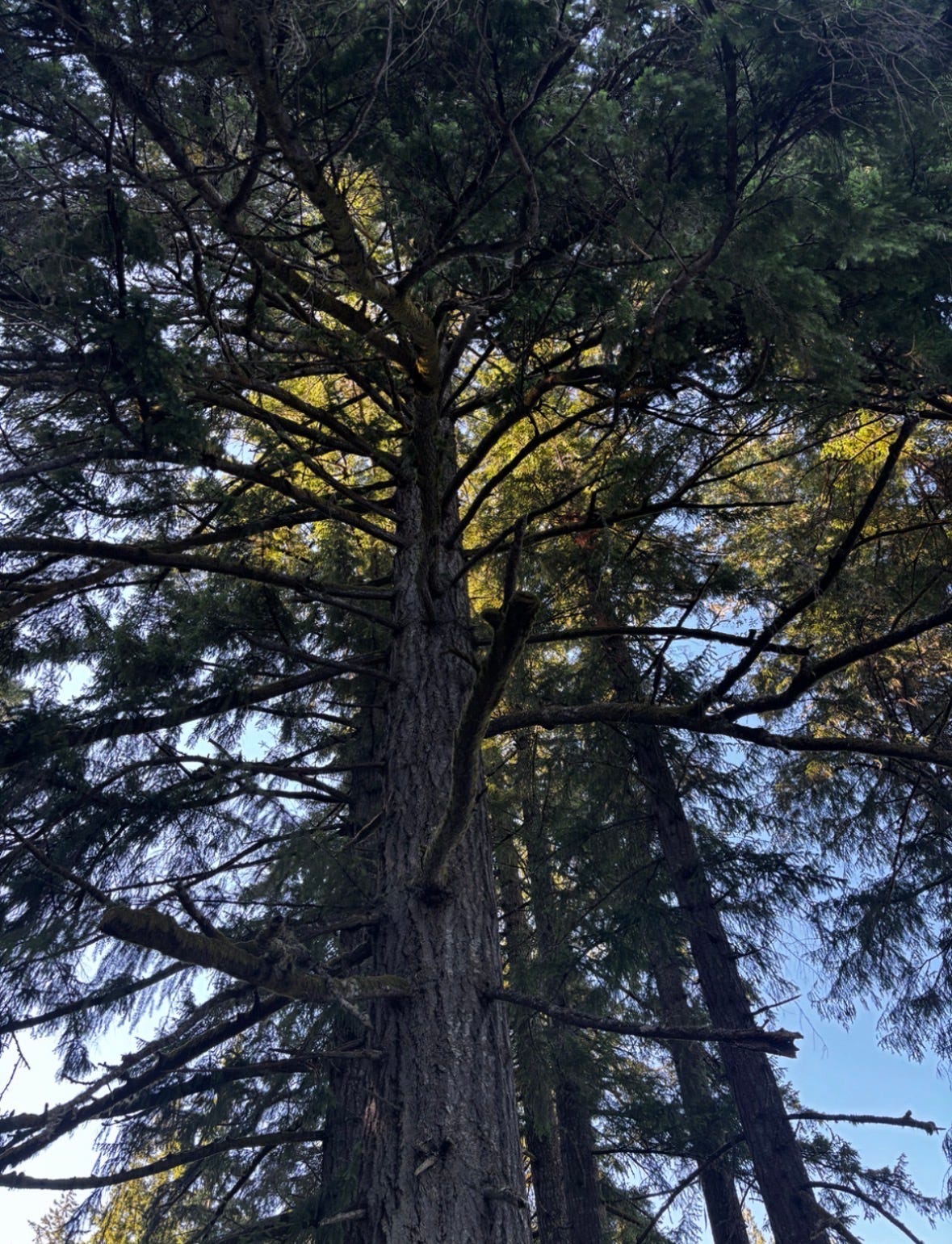
He drew trees.
When my thoughts became too numerous to hold all at once—and they generally did—he would help me put them somewhere. The thoughts became leaves. Leaves belonged to branches. Branches joined the trunk. And the trunk had to reach the roots.
I would fill the tree and give the leaves different colors. Once the colors spread across it, patterns became visible that I could not always see in the words alone.
Too much of one color. Too little of another.
Sometimes a color was missing entirely.
I still think this way.
When I ask whether an idea holds, what I really want to know is whether I can trace it all the way down.
Leaf.
Branch.
Trunk.
Root.
Is it actually attached?
Or have I found something beautiful and hung it on the tree because I wanted it there?
A beautiful leaf without a root is still a beautiful leaf without a root.
And I cannot stand on every side of the tree at once.
My father taught me to do the best work I could first. Follow an idea as far as I could. Put it together carefully. Then hand it to someone who might know more than I did and ask them to poke holes in it.
I used to think the goal was to build something with no holes.
He taught me otherwise.
A hole was not necessarily the failure of an idea. Sometimes it was simply the place where another person could see what I could not.
The holes let more light fall on what I thought I had already seen.
What I can see need not be false simply because I cannot see everything.
But none of us should mistake our view for the whole tree.
We need other eyes.
⸻
When I look backward now, I keep returning to those circles around the fires.
I thought the older people were telling us stories.
They were.
But something larger was happening.
A person would begin a story and someone else would add to it. Another would correct a detail. Someone would remember a name. Someone would laugh because they knew what was coming.
No one person had to remember everything.
They brought what they knew into the circle.
A child might be hearing the story for the first time while an older person had heard it so many times that the first few words were enough to bring the whole thing back.
Some of the people in the stories were sitting beside us.
Some were no longer there to sit among us.
Some had left this life before I was born.
And still their letters were walking with ours.
I didn’t know the phrase Great Conversation then.
I only knew the circle.
But I was being taught something there that I have spent the rest of my life trying to understand.
The conversation had begun before I arrived.
That was true around those fires. It was true when I entered an American classroom. It was true when I encountered a language whose music I did not yet recognize.
And it is true every time I encounter another person.
I arrive somewhere in the middle.
Their story did not begin when I appeared in it. And if I am fortunate enough to be invited into some portion of it, I do not become its author.
I become, for however long I am there, one of its participants.
That was what my father was teaching the little girl who kept wondering where everybody had gone.
They had not disappeared.
The conversation had changed.
The music was unfamiliar.
I was waiting for gestures that did not come, listening for rhythms these people did not use, searching for fairies they had never expected to be there.
I had heard one kind of music and mistaken unfamiliar music for silence.
My father never asked me to stop hearing the music I knew.
He taught me to listen for theirs.
“We must learn where to enter the conversation and join in.”
And slowly, I did.
⸻
I still prefer ragazza. I cannot help it.
Say the word and I can still see her coming around the corner, moving too quickly, calling something over her shoulder.
And piazza will probably always contain more people for me than square does.
I still think fairy floss deserves fairies.
And I remain unconvinced that wishing someone a broken leg is an appropriate way to encourage them.
Some translations may be beyond me.
But I have learned to keep listening.
People are always carrying more story than the sentence in which I meet them. My view of the tree is never the only view. Another person’s music does not become silence simply because I have not yet learned its rhythm.
And somewhere, long before I knew what any of this meant, I sat in a great circle around numerous fires while copper kettles held love in the form of food and old people spoke the names of those who had gone before us.
The stories moved from one voice to another. The children listened. The absent were remembered. The living interrupted.
Everyone laughed.
And eventually the night sky broke open in color.
I thought we were having carnival.
We were participating in a story.
One that had begun before us and would continue after us.
We arrive somewhere in the middle. We listen for the story already being told. We learn where to enter.
We join in.
And for the little while our letters are allowed to walk alongside the others, we try to make something beautiful of the sentence.
The circle was already there when we arrived.
Someone had simply made room for us.
⸻
© Gilda Wray. All rights reserved.
I really liked reading this. What an interesting take. And what a lovely father you had. I love the concepts you learned. I will think of this when I’m interacting with others now.
Some of us fell into our coffee cups looking for the meaning of life :)