

“Bear one another’s burdens, and so fulfill the law of Christ.”
— Galatians 6:2
My father used to ask a question whenever we were outdoors together.
“You’re looking, but are you seeing?”
At the time, I thought he was talking about birds and trees.
Now I wonder if he was teaching me how to live.
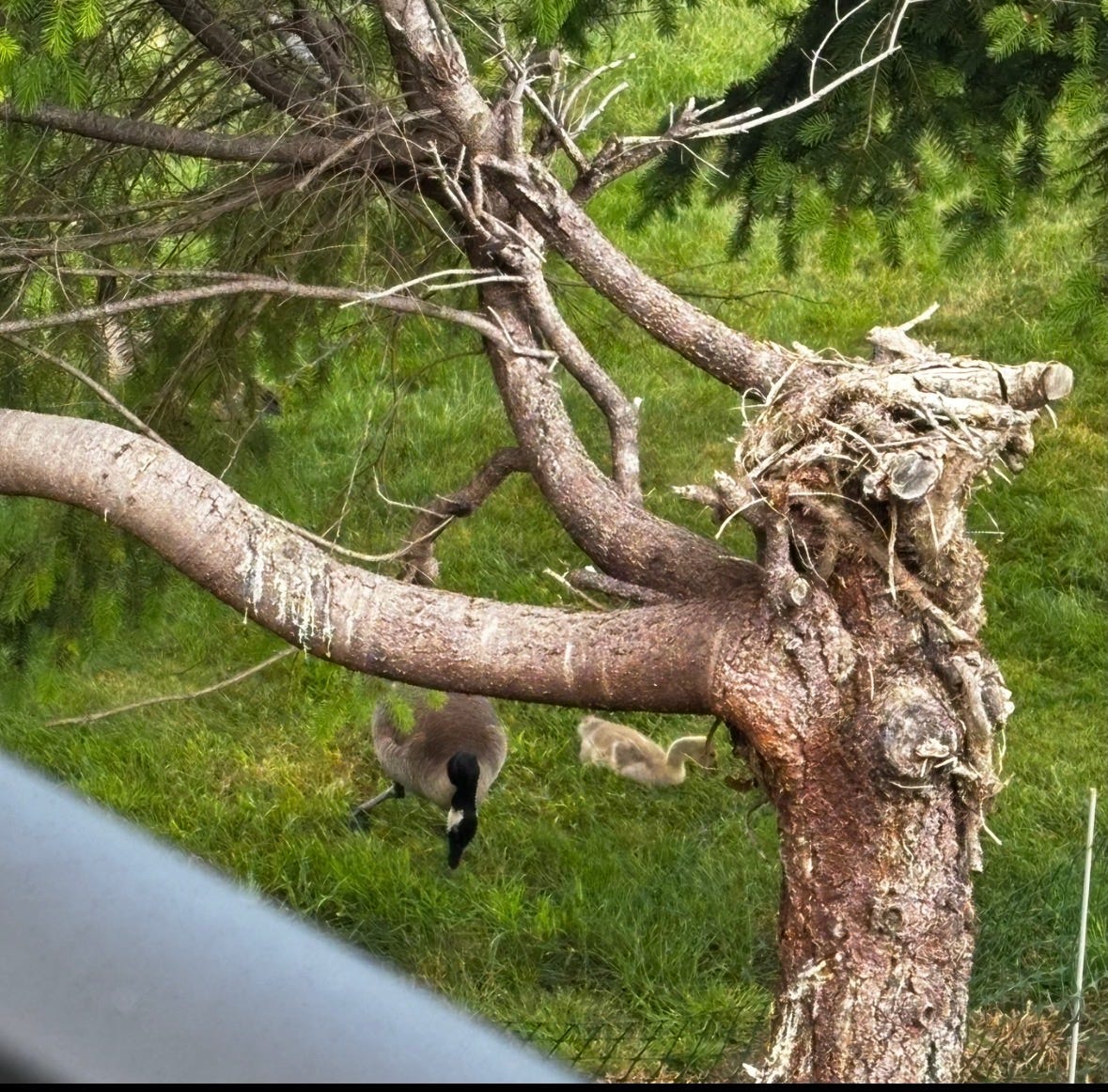
Recently, my husband and I began noticing a lone goose around the lake.
He has a bent knee and walks with a limp, as though an old injury healed in an awkward position.
Everywhere we looked there were pairs of geese and growing families of goslings, while he seemed to wander alone.
So we began affectionately calling him Forrest.
Over time, we found ourselves watching for him and quietly hoping he might somehow find a family of his own.
Then something unexpected happened.
A goose family with nine goslings began feeding regularly near our home.
Among the fluffy little procession was one tiny runt, barely half the size of the others.
He lagged behind.
Walked slower.
Ate slower.
Everything about him seemed just a little smaller than the rest.
And then we noticed something.
Forrest was with them.
Not at the center of the flock.
Not leading the family.
Just nearby.
Always nearby.
The little gosling seemed to keep pace with the bent-kneed goose.
And the bent-kneed goose, in turn, seemed to keep pace with the little gosling.
And it wasn’t a one-time occurrence.
Day after day, Forrest made the crossing.
Despite his bent knee and awkward gait, he swam across the lake, hobbled through the grass, stayed near the little gosling, and kept watch for danger.
There was something quietly beautiful about his faithfulness.
Love is often measured in grand gestures.
But perhaps it is just as often revealed in the simple decision to show up again tomorrow.
Perhaps burden-bearing often begins there—not in lifting someone out of weakness, but in loving them enough to keep pace with it.
This is why Paul can call this “the law of Christ”: because love does not remain an idea, but gives itself—stooping low enough to help carry what another cannot bear alone.
The one who limped.
The one who lagged.
Together.
I couldn’t help wondering if compassion often grows this way.
Those who know what it is to struggle are sometimes the quickest to notice those who struggle.
Those who have fallen behind are often the first to slow their pace for another.
Our wounds, once touched by grace, become places from which love can flow.
Day after day it seemed as though each had found companionship in the other.
And standing there, watching them, I heard my father’s voice. Not looking anymore. Seeing.
The goose who could not quite keep up.
The gosling who could not quite keep up.
Neither left behind.
Neither alone.
Each cared for.
Each helping the other.
Each belonging.
It made me wonder how often God’s care appears in forms we almost miss because we are looking for something grander.
We expect eagles.
He gives us a goose with a bad knee.
We expect miracles.
He gives us companionship.
We expect strength.
He gives us tenderness.
And perhaps that is miracle enough.
My father used to ask,
“You’re looking, but are you seeing?”
Most people would see a flock of geese.
I saw a bent-kneed goose and a tiny gosling walking through the grass together.
And somehow, in that small and ordinary moment, I caught a glimpse of grace.
Perhaps that is the way of the Kingdom.
Not always the strongest caring for the weakest.
Sometimes the wounded find one another and discover they were never meant to walk alone.
———
Thank you for reading. If this opened something for you too, I’d love to hear: when have you seen grace appear in a form you almost missed?
———
© Gilda Wray. All rights reserved.
Great Verse :)
Beautiful. I think God works in quiet ways, oftentimes, easy to overlook. I don't want to miss them.